- Home
- Catalogues
- List of Supervising Constructions for High School - High School 2025-2026
- Catalogue of Science and Technology Aids 2025-2026
- Design & Technology Catalogue Primary Schools 2024-2025
- Catalogue of Science and Technology Aids 2024-25
- Catalogue of Science and Technology Aids 2023-24
- Christmas Crafts Set
- Nursery Schools Catalogue 2022-2023
- Nursery Schools Catalogue 2020-2021
- Nursery Schools Catalogue 2018-2019
- Happy and Creative Hands
- Jobs Category
- About us
- FAQ
- Terms and conditions of use
- Privacy Policy
- Cookies Policy
- Payment Methods
- Shipping Methods
- Returns Policy
- Payment Response
- Registration Successful
- Shipments to Greece
- New Service Point
- Teacher Registration
- Box Now Shipping Service
- 40 years Antoniadis
- Catalogues
- Catalogues
- About us
- Payment Methods
-
Educational Products
-
School Equipment
- All
- Write 'N' Wipe Boards
- White Magnetic Boards
- Board Erasers & Cleaners
- Interactive Boards
- Cork Boards
- Boards Paper Roll
- Talking Points
- Measuring Instruments
- Rotary Trimmer & Guillotine Machines
- Binding Machines
- Laminators
- Maps
- Literacy
- Time
- Presenters
- Music Instruments
- Batteries
- USB Memory Sticks
- Pocket Charts
- Various
-
Stationery
-
STEM - Robotics - Programming
-
Electronics
-
Educational Toys & Construction Kits
- All
- Mechanics
- Robotics
- Coding
- Simple Circuit Kits
- Science
- Green Science
- Planets
- Dinosaurs - Volcanos
- Animals
- Lenses
- Logic / Understanding
- Card & Board Games
- Rubik's Cubes
- Puzzles
- Magnetic Boards
- Hama Beads
- Painting Sets
- Craft Sets
- Creative Hands
- Soft Play Dough
- Fridge Magnets
- Wooden toys
- Baby Toys
- Gadgets
- Construction "Antoniadis"
- Seasonal
- Birthday Gifts
- Gift Vouchers
-
Tools & Adhesives
-
Craft Materials
- All
- Resin Art, Casting & Sculpting
- Decoupage & Mixed Media
- Items for Decoration
- Model Making & Mockup Supplies
- Creation Materials
- Decoratives
- Paints - Colours
- Mediums & Auxiliaries
- Canvases & Canvas Panels
- Clocks & Accessories
- Cards & Papers
- Fabrics
- Scrapbooking - Papers
- Powertex
- Quilling
- Seasonal
- All
- Acrylics
- Metallic - Pearl
- Chalk Paints
- Oil Paints
- Watercolours - Temperas
- Glass paints
- Fabric Paints
- Pouring Paint Sets
- Face painting
- Lasur Paints
- Chalkboard
- Pencils
- Chalks
- Markers
- Pastel-Crayons
- Outliners
- Alcohol Inks
- Spray
- Pigments for Liquid Glass
- Pigments
- Coloring Books
- Painting by numbers
- Paint Palettes and Containers
-
Art Supplies
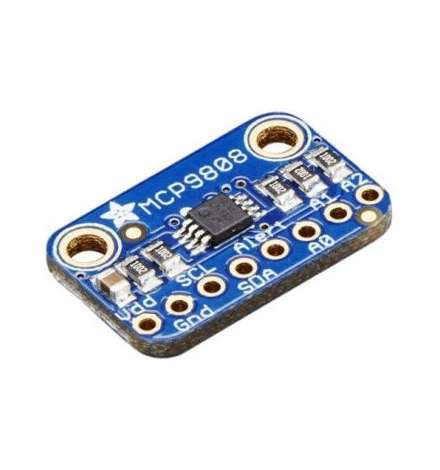
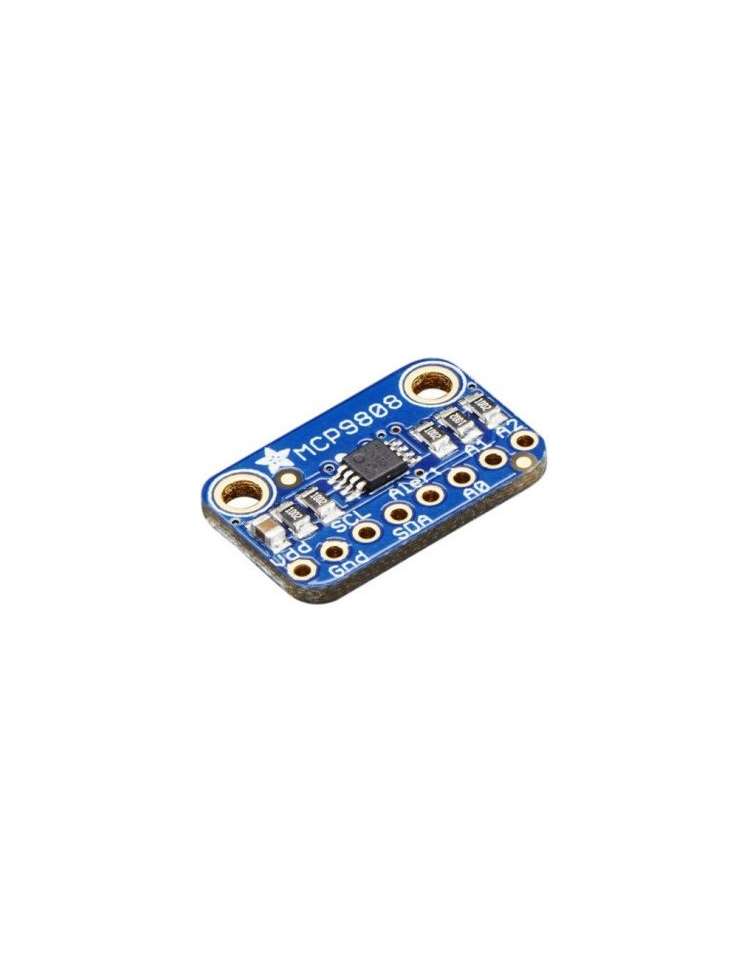
High Accuracy I2C Temperature Sensor Breakout Board - Adafruit
The Adafruit MCP9808 is one of the most accurate I2C digital temperature sensor breakout boards available, delivering a typical accuracy of ±0.25°C and a precision of ±0.0625°C across a wide operating range of -40°C to +125°C. Its broad supply voltage compatibility (2.7V to 5.5V) means it works seamlessly with virtually any modern microcontroller — from 5V Arduino boards to 3.3V ESP32 and Raspberry Pi systems — over standard I2C without any additional level shifting in most cases.
Key Features
- Typical Accuracy ±0.25°C: One of the highest-accuracy temperature sensors in its class → reliable readings for precision applications
- Resolution 0.0625°C: Fine-grained 13-bit temperature data → detect even the smallest temperature changes
- Operating Range -40°C to +125°C: Covers demanding environments from freezing cold to high heat → suitable for industrial and outdoor projects
- Wide Voltage Range 2.7V–5.5V: Compatible with both 5V and 3.3V logic systems → no level shifter needed for Arduino or ESP32/RPi
- Standard I2C Interface: Easy two-wire communication → minimal wiring, works with any I2C-capable microcontroller
- 3 Address Select Pins: Allows up to 8 MCP9808 sensors on the same I2C bus → multi-point temperature monitoring without address conflicts
- Breakout Board with Mounting Holes: Compact PCB design with mounting holes → easy mechanical integration into enclosures or custom builds
Pinout & Wiring
| PIN | Symbol | Description |
|---|---|---|
| Power | VDD | Supply voltage 2.7V–5.5V |
| Ground | GND | Common ground |
| Data | SDA | I2C data line |
| Clock | SCL | I2C clock line |
| Address | A0, A1, A2 | I2C address select pins (up to 8 devices per bus) |
Wiring note: Connect VDD to your board's 3.3V or 5V pin, GND to ground, SDA to the I2C data pin, and SCL to the I2C clock pin. Leave A0/A1/A2 unconnected for the default address, or tie to VDD/GND to set a custom address.
Compatibility
- Arduino UNO / Nano (5V): Connect directly — the MCP9808 accepts 5V logic with no additional components required.
- ESP32 / ESP8266 (3.3V): Fully compatible at 3.3V — ideal for IoT and wireless temperature logging projects.
- Raspberry Pi (3.3V): Works natively on the GPIO I2C pins — great for Python-based data logging.
- Any I2C microcontroller (2.7V–5.5V): Universal compatibility across the maker ecosystem.
Typical Applications
- Weather stations & environmental monitoring: Log temperature with high precision for home automation or outdoor sensor nodes.
- Industrial temperature control: Monitor critical temperatures in machinery or enclosures requiring tight accuracy.
- Multi-zone temperature mapping: Use up to 8 sensors on one I2C bus for room-by-room or multi-point thermal profiling.
- IoT data logging: Pair with ESP32 or RPi for wireless cloud-connected temperature monitoring.
- Education & prototyping: A perfect first I2C sensor project for students learning embedded systems and sensor interfacing.
Technical Specifications
| Specification | Value |
|---|---|
| Interface | I2C |
| Supply Voltage | 2.7V – 5.5V |
| Logic Voltage | 2.7V – 5.5V |
| Temperature Range | -40°C to +125°C |
| Typical Accuracy | ±0.25°C |
| Resolution / Precision | ±0.0625°C |
| Address Pins | 3 (A0, A1, A2) — up to 8 devices per bus |
| Form Factor | Breakout Board PCB with mounting holes |
| Brand | Adafruit |
| MPN | MCP9808 |
FAQ
Q: Can I use multiple MCP9808 sensors on the same Arduino I2C bus?
A: Yes — the three address pins (A0, A1, A2) allow you to configure up to 8 unique I2C addresses, so you can connect 8 sensors simultaneously on a single bus without any address conflicts.
Q: Does the MCP9808 need a level shifter with a 5V Arduino?
A: No — the sensor accepts supply and logic voltages from 2.7V to 5.5V, so it connects directly to both 5V Arduino and 3.3V ESP32/Raspberry Pi boards without additional components.
Note: Headers/connectors may need to be soldered separately. Check Adafruit's documentation for the latest library and wiring guide.