Ελληνικά
Your cart
There are no more items in your cart
 Educational Products
 School Equipment
 Stationery
 STEM - Robotics - Programming
 Electronics
 Educational Toys & Construction Kits
 Tools & Adhesives
 Craft Materials
 Art Supplies
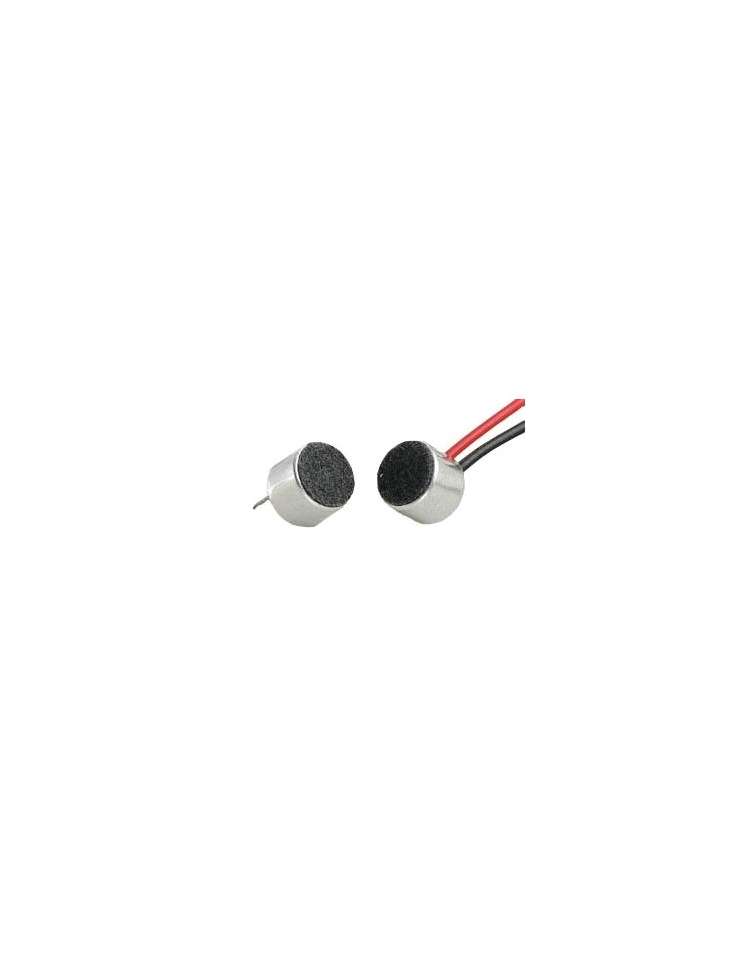
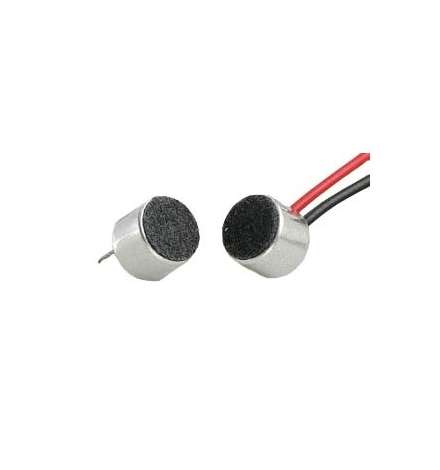
The 594-066 Electret Condenser Microphone Insert (OEM) is a compact, omni-directional capsule designed for embedding into custom audio circuits, sensor modules, and voice-detection projects. It captures sound equally from all directions (360°), operates from a wide 1.5–10V supply, and fits boards or enclosures thanks to its standard 10 mm × 7 mm form factor. RoHS compliant, it is a go-to choice for makers and engineers who need a reliable raw microphone element to solder directly onto a PCB or into a housing.
| Terminal | Symbol | Description |
|---|---|---|
| + | VCC / Drain | Connect to positive supply (1.5–10V) through a bias resistor (typically 2.2 kΩ–10 kΩ) |
| − | GND / Source | Connect to circuit ground; also the capsule body/case |
Wiring note: The microphone insert has two solder pads on its base — the pad connected to the metal case is GND, the other is the signal/VCC drain. A bias resistor between VCC and the drain pad is required; the audio signal is taken from the drain pad via a coupling capacitor. The capsule ships without cables and must be soldered.
| Parameter | Value |
|---|---|
| Type | Electret Condenser (Omni-directional) |
| Supply Voltage | 1.5 – 10 V |
| Current Drain | < 0.5 mA |
| Frequency Response | 50 Hz – 13 kHz |
| Impedance | 300 Ω |
| Maximum Input SPL | 120 dB |
| Diameter | 10 mm |
| Height | 7 mm |
| RoHS | Compliant |
| MPN | 594-066 |
Q: Does the microphone insert come with cables or a connector?
A: No — it is a bare capsule with two solder pads on the base. You need to solder wires or mount it directly on a PCB.
Q: Do I need an amplifier to use this with an Arduino?
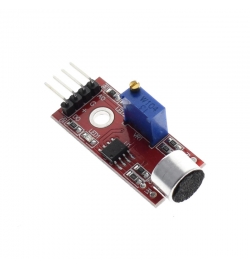
A: Yes, in most cases. The raw signal from an electret capsule is very small. A preamp stage (discrete transistor, LM386, or a ready-made module like the KY-038) is recommended before connecting to a microcontroller ADC.