- Home
- Catalogues
- List of Supervising Constructions for High School - High School 2025-2026
- Catalogue of Science and Technology Aids 2025-2026
- Design & Technology Catalogue Primary Schools 2024-2025
- Catalogue of Science and Technology Aids 2024-25
- Catalogue of Science and Technology Aids 2023-24
- Christmas Crafts Set
- Nursery Schools Catalogue 2022-2023
- Nursery Schools Catalogue 2020-2021
- Nursery Schools Catalogue 2018-2019
- Happy and Creative Hands
- Jobs Category
- About us
- FAQ
- Terms and conditions of use
- Privacy Policy
- Cookies Policy
- Payment Methods
- Shipping Methods
- Returns Policy
- Payment Response
- Registration Successful
- Shipments to Greece
- New Service Point
- Teacher Registration
- Box Now Shipping Service
- 40 years Antoniadis
- Catalogues
- Catalogues
- About us
- Payment Methods
-
Educational Products
-
School Equipment
- All
- Write 'N' Wipe Boards
- White Magnetic Boards
- Board Erasers & Cleaners
- Interactive Boards
- Cork Boards
- Boards Paper Roll
- Talking Points
- Measuring Instruments
- Rotary Trimmer & Guillotine Machines
- Binding Machines
- Laminators
- Maps
- Literacy
- Time
- Presenters
- Music Instruments
- Batteries
- USB Memory Sticks
- Pocket Charts
- Various
-
Stationery
-
STEM - Robotics - Programming
-
Electronics
-
Educational Toys & Construction Kits
- All
- Mechanics
- Robotics
- Coding
- Simple Circuit Kits
- Science
- Green Science
- Planets
- Dinosaurs - Volcanos
- Animals
- Lenses
- Logic / Understanding
- Card & Board Games
- Rubik's Cubes
- Puzzles
- Magnetic Boards
- Hama Beads
- Painting Sets
- Craft Sets
- Creative Hands
- Soft Play Dough
- Fridge Magnets
- Wooden toys
- Baby Toys
- Gadgets
- Construction "Antoniadis"
- Seasonal
- Birthday Gifts
- Gift Vouchers
-
Tools & Adhesives
-
Craft Materials
- All
- Resin Art, Casting & Sculpting
- Decoupage & Mixed Media
- Items for Decoration
- Model Making & Mockup Supplies
- Creation Materials
- Decoratives
- Paints - Colours
- Mediums & Auxiliaries
- Canvases & Canvas Panels
- Clocks & Accessories
- Cards & Papers
- Fabrics
- Scrapbooking - Papers
- Powertex
- Quilling
- Seasonal
- All
- Acrylics
- Metallic - Pearl
- Chalk Paints
- Oil Paints
- Watercolours - Temperas
- Glass paints
- Fabric Paints
- Pouring Paint Sets
- Face painting
- Lasur Paints
- Chalkboard
- Pencils
- Chalks
- Markers
- Pastel-Crayons
- Outliners
- Alcohol Inks
- Spray
- Pigments for Liquid Glass
- Pigments
- Coloring Books
- Painting by numbers
- Paint Palettes and Containers
-
Art Supplies
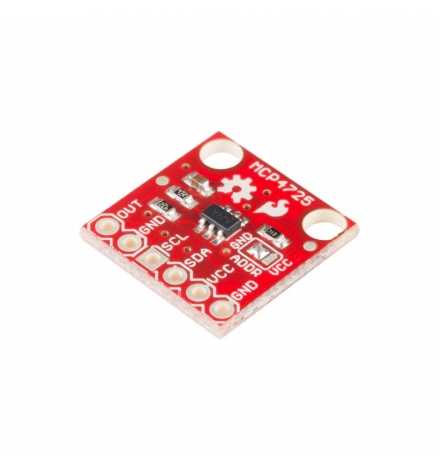
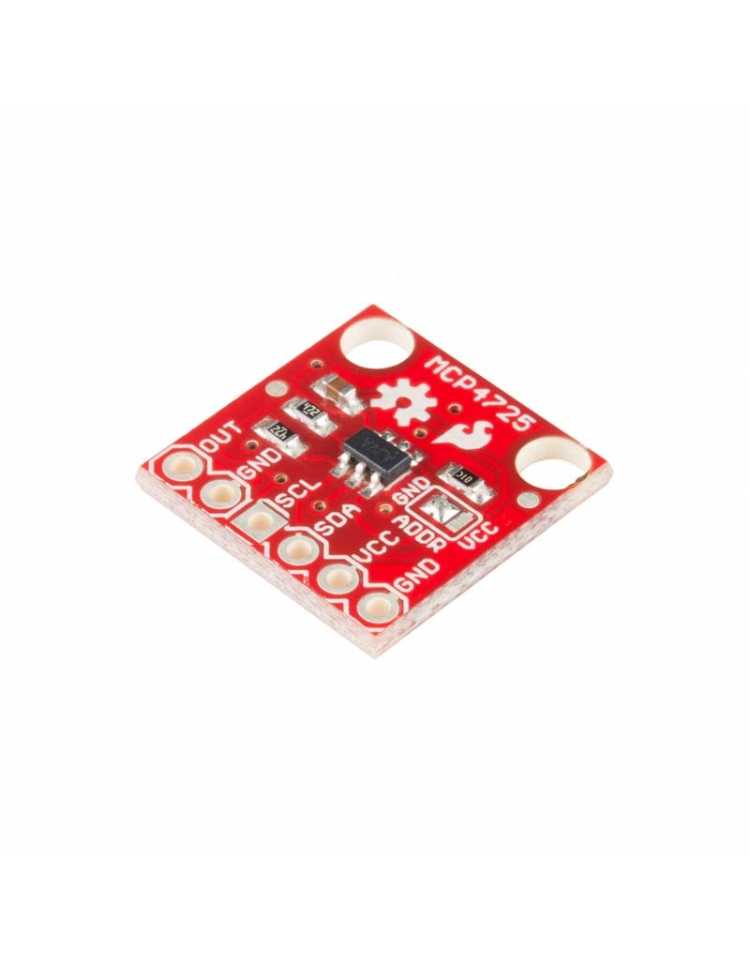
Breakout Board for MCP4725 I2C DAC
The MCP4725 Breakout Board (MPN: MCP4725) is a compact, easy-to-use I2C Digital-to-Analog Converter (DAC) module that lets your microcontroller output true analog voltages — something a standard PWM pin simply cannot achieve. Whether you're generating a sine wave, driving an analog circuit, or building a musical instrument, the MCP4725 bridges the digital world and the analog domain with minimal wiring.
Key Features
- I2C Interface: Uses just two wires (SDA + SCL) → leaves most GPIO pins free for other tasks
- 12-bit Resolution: 4096 discrete output voltage steps → smooth, precise analog output
- Non-volatile EEPROM: Stores the last DAC value → output is restored automatically on power-up
- Breakout Board Format: All pins broken out on 0.1" headers → breadboard and perfboard compatible
- Revised Board Design: This version corrects the IC footprint and I2C pinout found in earlier revisions → improved reliability and easier wiring
Pinout & Wiring
| PIN | Symbol | Description |
|---|---|---|
| 1 | VCC | Supply voltage (2.7V – 5.5V) |
| 2 | GND | Ground |
| 3 | SCL | I2C Clock |
| 4 | SDA | I2C Data |
| 5 | OUT | Analog voltage output |
Wiring note: Connect VCC and GND to your supply, then SCL→SCL and SDA→SDA on your microcontroller. The analog voltage appears on the OUT pin. Pull-up resistors on SDA/SCL are recommended if not already present on your board.
Compatibility
- Arduino UNO / Nano (5V): Connect VCC to 5V; use the built-in Wire library with the standard I2C address (0x60 or 0x61).
- ESP32 / ESP8266 (3.3V): Connect VCC to 3.3V; fully compatible — the MCP4725 operates down to 2.7V.
- Raspberry Pi (3.3V): Compatible via the I2C bus; enable I2C in raspi-config before use.
Typical Applications
- Audio & sound generation: Output sine waves or arbitrary waveforms for simple synthesizers and sound effects circuits.
- Musical instruments & CV control: Drive voltage-controlled oscillators (VCOs) in DIY synth projects.
- Analog sensor simulation: Replace a physical sensor with a precise, software-controlled voltage source during prototyping.
- Motor & LED dimming: Provide a smooth analog control voltage to motor drivers or LED drivers that accept a voltage reference.
- Data logging & test equipment: Generate calibration voltages for analog front-end circuits.
Technical Specifications
| Parameter | Value |
|---|---|
| Interface | I2C |
| DAC Resolution | 12-bit (4096 steps) |
| Supply Voltage (VCC) | 2.7V – 5.5V |
| Output Voltage Range | 0V – VCC |
| On-board Memory | EEPROM (non-volatile) |
| Form Factor | Breakout Board with 0.1" headers |
| MPN | MCP4725 |
FAQ
Q: Can I have two MCP4725 modules on the same I2C bus?
A: Yes. The MCP4725 supports two selectable I2C addresses (0x60 and 0x61) via an address pin, allowing two modules on a single bus simultaneously.
Q: Does the MCP4725 remember its output value after a power cycle?
A: Yes — writing to the EEPROM (instead of just the DAC register) saves the value permanently, so the module restores the same output voltage on the next power-up.
⚠ Note: The analog output voltage cannot exceed VCC. Ensure your load impedance is appropriate for the DAC output stage. Always connect GND between the module and the microcontroller before applying power.