Ελληνικά
Your cart
There are no more items in your cart
 Educational Products
 School Equipment
 Stationery
 STEM - Robotics - Programming
 Electronics
 Educational Toys & Construction Kits
 Tools & Adhesives
 Craft Materials
 Art Supplies
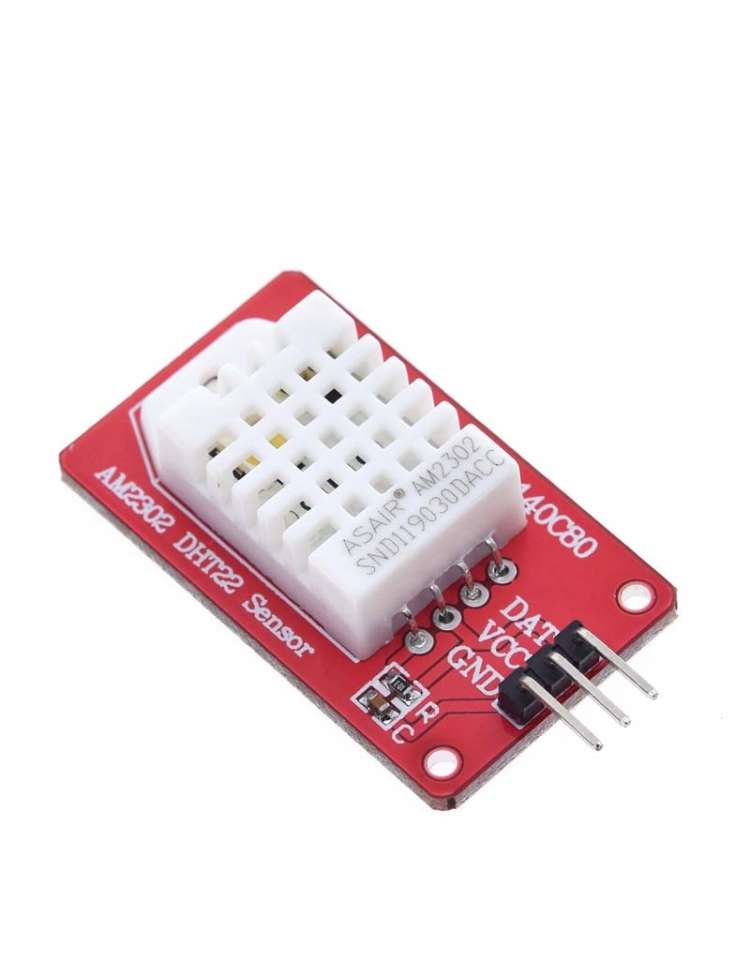
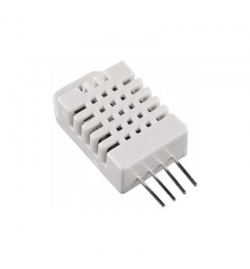
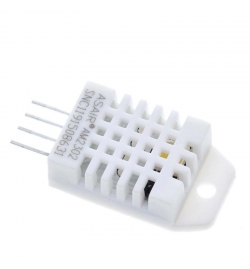
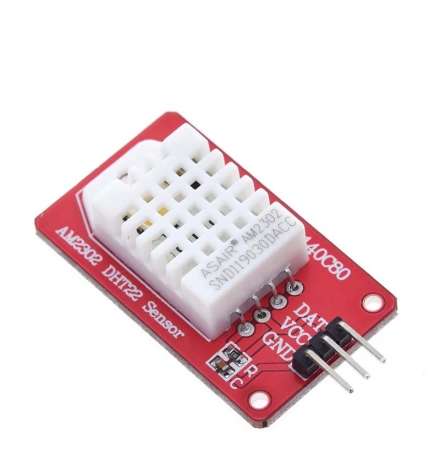
The DHT22 (AM2302) — MPN: DHT-22 — is a calibrated digital temperature and humidity sensor module designed for makers, students, and engineers who need reliable ambient environment monitoring. Unlike its simpler sibling the DHT11, the DHT22 offers higher measurement accuracy and a wider sensing range, making it the go-to choice for weather stations, smart home systems, and data-logging applications. It communicates over a single-wire digital interface, minimising the GPIO pins required on your microcontroller.
| PIN | Symbol | Description |
|---|---|---|
| 1 | VCC | Power supply – connect to 3.3V or 5V |
| 2 | DATA | Single-wire digital data output – connect to a GPIO pin |
| 3 | GND | Ground – connect to GND |
Wiring note: A pull-up resistor (typically 4.7kΩ–10kΩ) on the DATA line to VCC is recommended for reliable communication. Many ready-made modules include this resistor onboard — check your specific board before adding one externally.
| Parameter | Value |
|---|---|
| Interface | Digital – Single Wire |
| Typical Input Voltage | 3.3V / 5V / 5.5V DC |
| Operating Current | 1.5mA |
| Sensor Type | Temperature & Humidity |
| Communication Protocol | Single Wire |
| Onboard Sensor | DHT22 (AM2302) |
| MPN | DHT-22 |
Q: What is the difference between DHT11 and DHT22?
A: The DHT22 (AM2302) provides higher measurement accuracy and a wider sensing range compared to the DHT11. If your project requires more precise readings, the DHT22 is the better choice.
Q: Do I need an external pull-up resistor?
A: A 4.7kΩ–10kΩ pull-up resistor on the DATA line is generally recommended by the datasheet. Many pre-assembled modules include it onboard, so check before adding one yourself.