Ελληνικά
Your cart
There are no more items in your cart

 Educational Products
 School Equipment
 Stationery
 STEM - Robotics - Programming
 Electronics
 Educational Toys & Construction Kits
 Tools & Adhesives
 Craft Materials
 Art Supplies
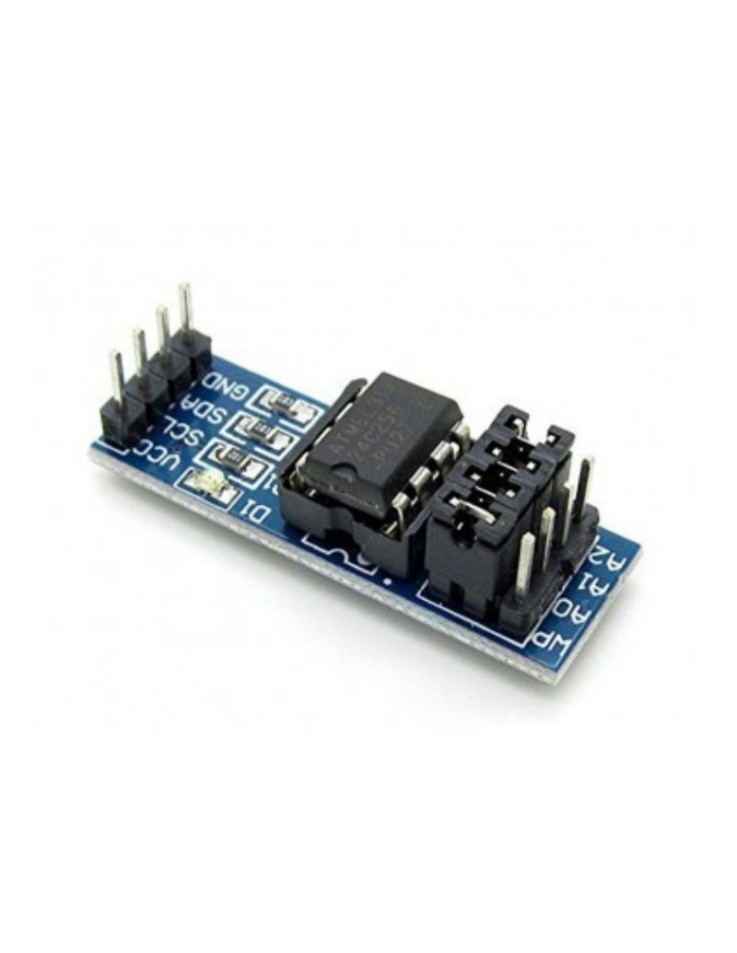
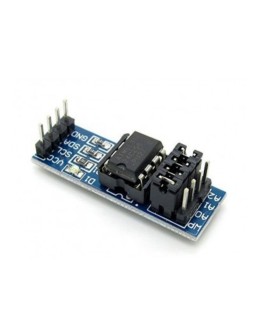
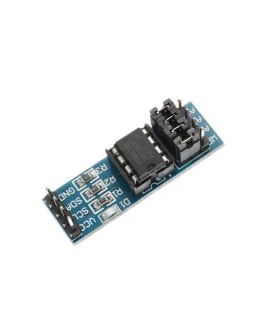
The AT24C256 EEPROM Memory Module (MPN: AT24C256) is a compact, non-volatile memory expansion board designed for microcontroller projects that need persistent data storage. With 256 Kbit (32 KB) of EEPROM capacity and a standard I2C (Two-Wire Interface) bus, it lets you store configuration settings, calibration data, log files, or user preferences that survive power cycles — all without occupying precious internal flash on your microcontroller.
| PIN | Symbol | Description |
|---|---|---|
| 1 | A0 | I2C address bit 0 (jumper) |
| 2 | A1 | I2C address bit 1 (jumper) |
| 3 | A2 | I2C address bit 2 (jumper) |
| 4 | GND | Ground |
| 5 | VCC | Power supply |
| 6 | SCL | I2C clock line |
| 7 | SDA | I2C data line |
| 8 | WP | Write Protect (connect to GND to enable writes) |
Wiring note: Connect SDA → SDA and SCL → SCL on your microcontroller. Add 4.7 kΩ pull-up resistors on both lines if not already present on your board. Leave WP pin connected to GND to allow write operations.
| Parameter | Value |
|---|---|
| Interface | I2C (Two-Wire) |
| Memory Capacity | 256 Kbit (32 KB) |
| Address Pins | A0, A1, A2 (up to 8 devices on one bus) |
| MPN | AT24C256 |
Q: How many AT24C256 modules can I connect to the same I2C bus?
A: Up to 8 modules, because the three address jumpers (A0, A1, A2) provide 2³ = 8 unique I2C addresses (0x50–0x57), giving a combined capacity of up to 256 KB.
Q: Do I need external pull-up resistors?
A: The module includes pull-up resistors on the SDA and SCL lines on the PCB. When connecting multiple modules on the same bus, you may need to remove redundant pull-ups to avoid too-low bus impedance.