Ελληνικά
Your cart
There are no more items in your cart
 Educational Products
 School Equipment
 Stationery
 STEM - Robotics - Programming
 Electronics
 Educational Toys & Construction Kits
 Tools & Adhesives
 Craft Materials
 Art Supplies
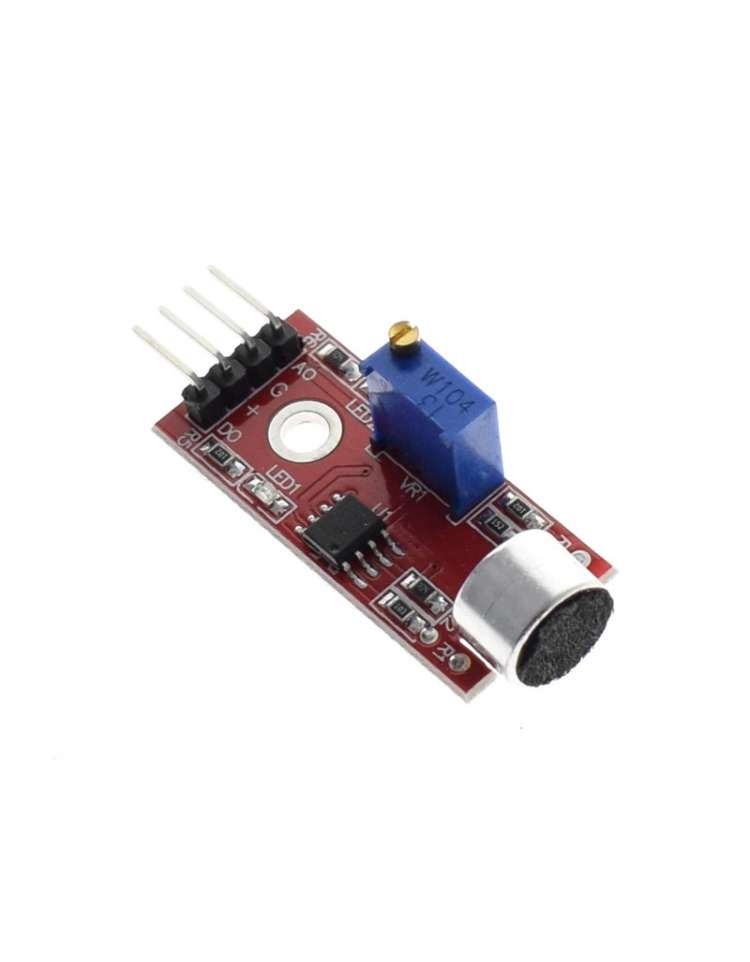
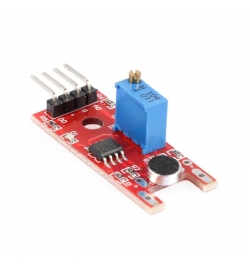
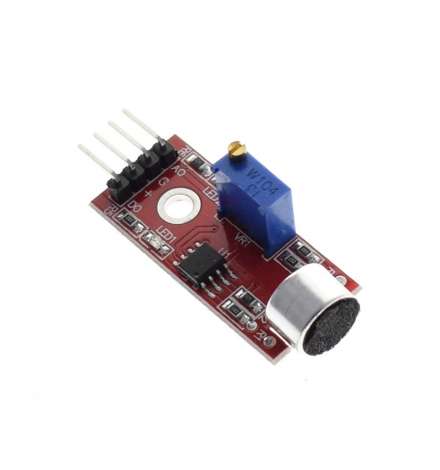
The KY-037 (OEM) is a high-sensitivity sound microphone sensor detection module designed for Arduino-based sound detection and noise-triggered automation projects. Operating on a 5V DC supply, it provides two output modes — analog (AO) and digital (DO) — giving makers full flexibility whether they need precise audio level readings or simple threshold-based triggering. Its onboard comparator and potentiometer make it one of the most beginner-friendly audio sensor modules for microcontroller platforms.
| PIN | Symbol | Description |
|---|---|---|
| 1 | VCC | Power supply — connect to 5V |
| 2 | GND | Ground |
| 3 | DO | Digital output — HIGH/LOW based on sound threshold |
| 4 | AO | Analog output — real-time voltage proportional to sound level |
Wiring note: Connect VCC → 5V, GND → GND, DO → any Arduino digital pin (e.g. D3), AO → any Arduino analog pin (e.g. A0). Adjust the onboard potentiometer to set the desired digital trigger threshold.
| Parameter | Value |
|---|---|
| Interface | Analog (AO) + Digital (DO) |
| Operating Voltage | 5V DC |
| Digital Output | High / Low (threshold-based) |
| Analog Output | Real-time voltage signal |
| Threshold Adjustment | Onboard potentiometer |
| Mounting Hole | 3mm screw hole |
| Indicator LEDs | Power LED + Comparator output LED |
| MPN | KY-037 |
Q: What is the difference between the AO and DO outputs on the KY-037?
A: The AO (analog output) provides a continuous voltage signal that varies with sound intensity — useful for measuring sound levels. The DO (digital output) switches between HIGH and LOW only when the sound exceeds the threshold set by the onboard potentiometer — useful for simple on/off triggering.
Q: Can I use the KY-037 with an ESP32 or ESP8266?
A: The module requires 5V power, which both boards can supply via their VIN/5V pin. However, since ESP32/ESP8266 GPIO pins are 3.3V logic, connect DO through a logic-level shifter to protect the GPIO. The AO pin can connect to the ESP32's ADC input directly only if your board provides a 3.3V-compatible analog signal range — verify the actual output voltage range before connecting.