Ελληνικά
Your cart
There are no more items in your cart

 Educational Products
 School Equipment
 Stationery
 STEM - Robotics - Programming
 Electronics
 Educational Toys & Construction Kits
 Tools & Adhesives
 Craft Materials
 Art Supplies
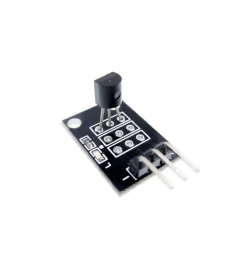
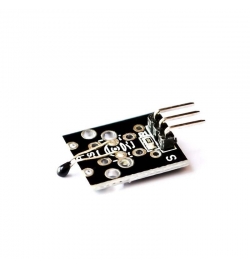
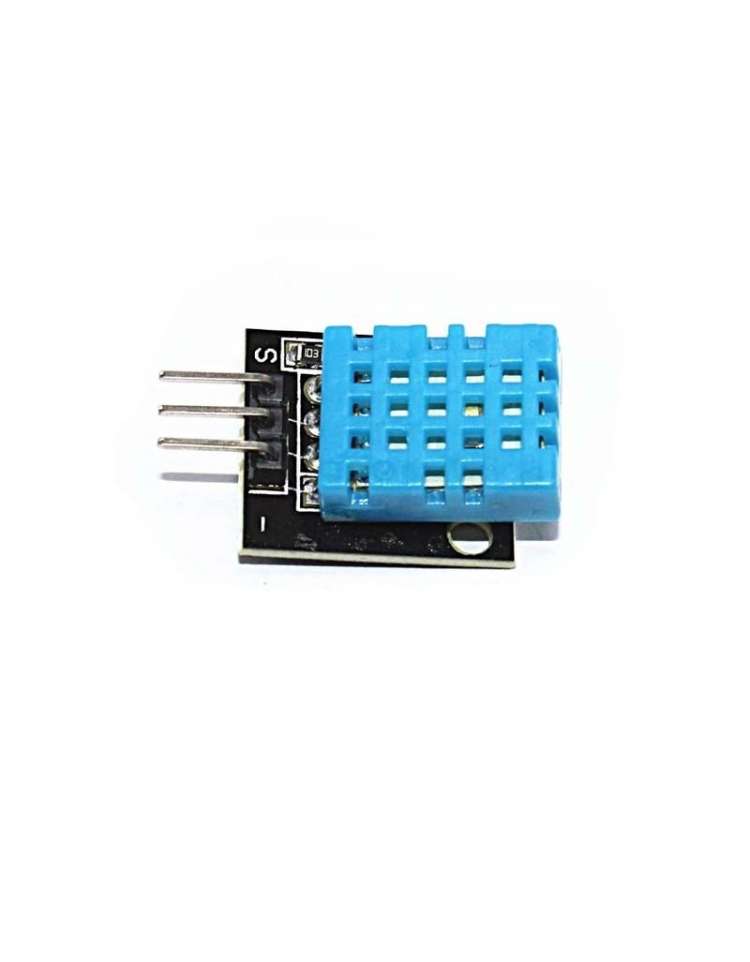
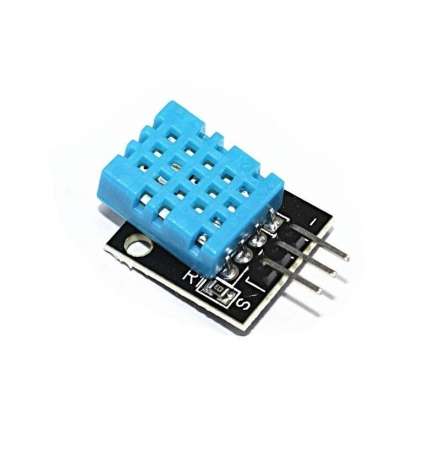
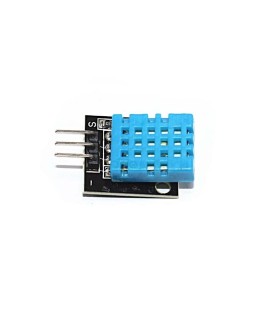
The KY-015 DHT-11 is a compact, low-cost digital temperature and humidity sensor module designed for easy integration into maker and engineering projects. Using a factory-calibrated sensing element and a single-wire digital output, the KY-015 eliminates the need for ADC circuitry and delivers ready-to-read data with minimal wiring. The 3-pin module format (VCC, DATA, GND) makes it a plug-and-play choice for Arduino, ESP32, and Raspberry Pi boards operating on 3.3 V or 5 V.
| Pin | Symbol | Description |
|---|---|---|
| 1 | VCC (S) | Power supply 3.3–5.5 V DC |
| 2 | DATA | Single-wire digital data output (connect to any GPIO) |
| 3 | GND (–) | Ground |
Wiring note: Connect VCC to your board's 3.3 V or 5 V rail, GND to ground, and DATA to any free digital GPIO pin. Use the DHT library (Arduino) or Adafruit_DHT / dht (MicroPython) — no pull-up resistor is required as the module PCB already includes it.
| Parameter | Value |
|---|---|
| Interface | Single-Wire Digital (1-Wire protocol) |
| Supply Voltage | 3.3 – 5.5 V DC |
| Temperature Range | 0 – 50 °C |
| Temperature Accuracy | ±2 °C |
| Temperature Resolution | 1 °C |
| Humidity Range | 20 – 90 %RH (with 0–50 °C compensation) |
| Humidity Accuracy | ±5 %RH |
| Humidity Resolution | 1 %RH |
| Response Time | < 5 seconds |
| Calibration | Factory full-scale calibration (OTP stored) |
| MPN | KY-015 |
Q: Do I need an external pull-up resistor for the data line?
A: No. The KY-015 module PCB already includes the pull-up resistor on the DATA line, unlike bare DHT-11 sensors.
Q: Can I use more than one KY-015 on the same microcontroller?
A: Yes — because the protocol is single-wire (not shared bus), connect each module's DATA pin to a separate GPIO pin and instantiate a separate DHT object per sensor in your code.