- Home
- Catalogues
- List of Supervising Constructions for High School - High School 2025-2026
- Catalogue of Science and Technology Aids 2025-2026
- Design & Technology Catalogue Primary Schools 2024-2025
- Catalogue of Science and Technology Aids 2024-25
- Catalogue of Science and Technology Aids 2023-24
- Christmas Crafts Set
- Nursery Schools Catalogue 2022-2023
- Nursery Schools Catalogue 2020-2021
- Nursery Schools Catalogue 2018-2019
- Happy and Creative Hands
- Jobs Category
- About us
- FAQ
- Terms and conditions of use
- Privacy Policy
- Cookies Policy
- Payment Methods
- Shipping Methods
- Returns Policy
- Payment Response
- Registration Successful
- Shipments to Greece
- New Service Point
- Teacher Registration
- Box Now Shipping Service
- 40 years Antoniadis
- Catalogues
- Catalogues
- About us
- Payment Methods
-
Educational Products
-
School Equipment
- All
- Write 'N' Wipe Boards
- White Magnetic Boards
- Board Erasers & Cleaners
- Interactive Boards
- Cork Boards
- Boards Paper Roll
- Talking Points
- Measuring Instruments
- Rotary Trimmer & Guillotine Machines
- Binding Machines
- Laminators
- Maps
- Literacy
- Time
- Presenters
- Music Instruments
- Batteries
- USB Memory Sticks
- Pocket Charts
- Various
-
Stationery
-
STEM - Robotics - Programming
-
Electronics
-
Educational Toys & Construction Kits
- All
- Mechanics
- Robotics
- Coding
- Simple Circuit Kits
- Science
- Green Science
- Planets
- Dinosaurs - Volcanos
- Animals
- Lenses
- Logic / Understanding
- Card & Board Games
- Rubik's Cubes
- Puzzles
- Magnetic Boards
- Hama Beads
- Painting Sets
- Craft Sets
- Creative Hands
- Soft Play Dough
- Fridge Magnets
- Wooden toys
- Baby Toys
- Gadgets
- Construction "Antoniadis"
- Seasonal
- Birthday Gifts
- Gift Vouchers
-
Tools & Adhesives
-
Craft Materials
- All
- Resin Art, Casting & Sculpting
- Decoupage & Mixed Media
- Items for Decoration
- Model Making & Mockup Supplies
- Creation Materials
- Decoratives
- Paints - Colours
- Mediums & Auxiliaries
- Canvases & Canvas Panels
- Clocks & Accessories
- Cards & Papers
- Fabrics
- Scrapbooking - Papers
- Powertex
- Quilling
- Seasonal
- All
- Acrylics
- Metallic - Pearl
- Chalk Paints
- Oil Paints
- Watercolours - Temperas
- Glass paints
- Fabric Paints
- Pouring Paint Sets
- Face painting
- Lasur Paints
- Chalkboard
- Pencils
- Chalks
- Markers
- Pastel-Crayons
- Outliners
- Alcohol Inks
- Spray
- Pigments for Liquid Glass
- Pigments
- Coloring Books
- Painting by numbers
- Paint Palettes and Containers
-
Art Supplies
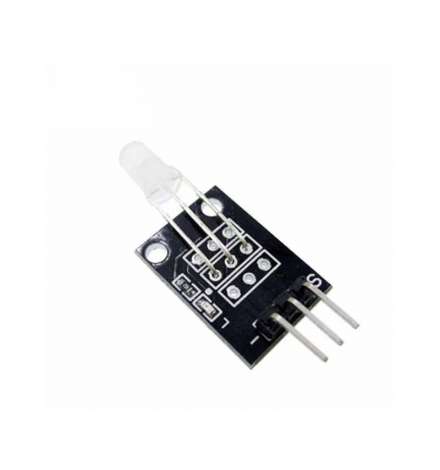
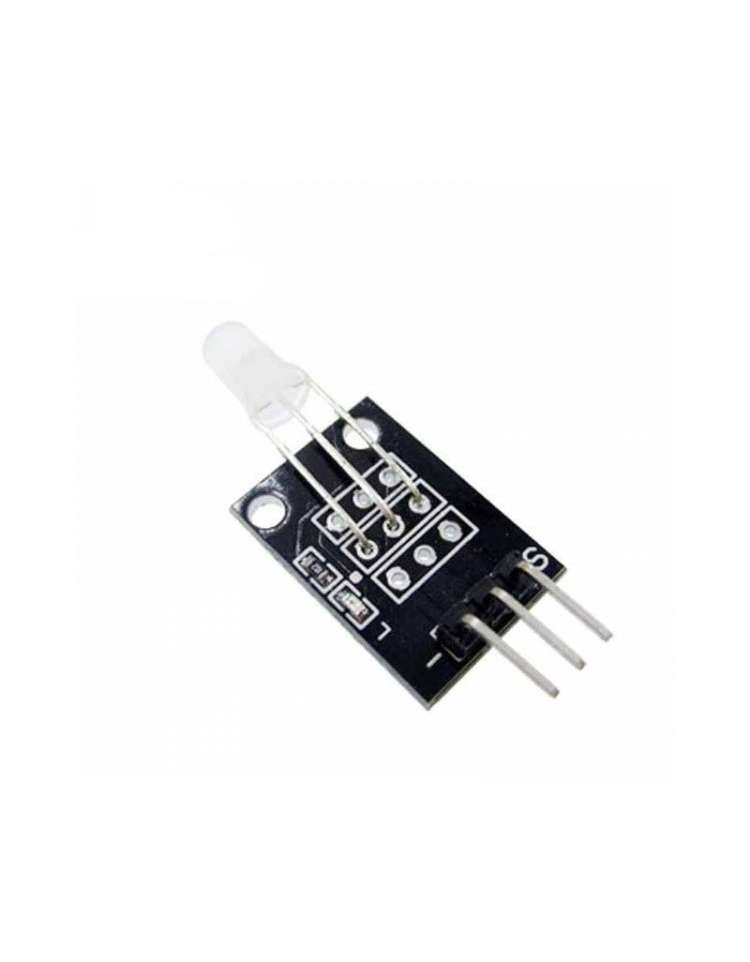
Two Color LED (Red & Green) Module KY-011
The KY-011 (MPN: KY-011) is a Two-Color LED Module featuring a common-cathode red & green bi-color LED mounted on a compact 3-pin board. It is widely used in Arduino-based projects where a single component needs to signal two distinct states — for example green for OK and red for error — without occupying multiple GPIO pins for separate LEDs. The module ships ready to plug into a breadboard or sensor shield.
Key Features
- Bi-Color LED (Red & Green): One 5 mm diffused LED emits both red (644 nm) and green (571 nm) → two status signals from one component
- Common Cathode Design: Both LED channels share a single ground pin → simpler wiring, fewer connections
- Wide Viewing Angle (150°): Diffused package spreads light broadly → visible from almost any angle
- PWM-Compatible: Each color channel can be driven with PWM → adjustable brightness and color mixing
- 3-Pin Header: Standard 2.54 mm pitch → direct fit on Arduino sensor shields and breadboards
- High Luminous Intensity: Green 20–40 mcd / Red 40–80 mcd → clearly visible indicator even in ambient light
Pinout & Wiring
| PIN | Symbol | Description |
|---|---|---|
| 1 | GND | Common cathode — connect to Arduino GND |
| 2 | R | Red LED anode — connect via 220 Ω resistor to Arduino digital/PWM pin |
| 3 | G | Green LED anode — connect via 220 Ω resistor to Arduino digital/PWM pin |
⚠️ Important: The on-board link provides no current limiting. Always add an external 220 Ω resistor on each signal pin when powering from 5 V. On a 5 V supply with ~2 V LED forward voltage, a 220 Ω resistor passes approximately 13 mA per channel — bright and safely within the 20 mA maximum.
Compatibility
- Arduino UNO / Nano / Mega (5 V): Fully compatible — use 220 Ω current-limiting resistors on R and G pins as described above.
- ESP32 / Raspberry Pi (3.3 V): Can be used with caution — at 3.3 V the forward voltage drop leaves less headroom; use a 100 Ω resistor and verify current stays under 20 mA.
Typical Applications
- Status indicators: Show system state (green = running, red = fault) in Arduino or microcontroller projects
- Traffic light simulations: Teach basic GPIO and PWM control in educational and STEM projects
- Battery level displays: Green for charged, red for low — simple visual feedback without a screen
- Game controllers & interactive props: Single-LED color feedback for score or life events in maker games
- Alarm systems: Visual alert output alongside a buzzer module (e.g. KY-012) for multi-sensory notification
Technical Specifications
| Parameter | Value |
|---|---|
| Interface | Digital / PWM |
| Forward Voltage (Vf) | 2.0 V – 2.5 V |
| Forward Current (If) max | 20 mA per channel |
| LED Diameter | 5 mm |
| Package Type | Diffusion |
| Viewing Angle | 150° |
| Wavelength — Green | 571 nm |
| Wavelength — Red | 644 nm |
| Luminous Intensity — Green | 20–40 mcd |
| Luminous Intensity — Red | 40–80 mcd |
| LED Type | Common Cathode, Bi-Color |
| Connector | 3-pin 2.54 mm header |
| MPN | KY-011 |
FAQ
Q: Do I need a resistor with the KY-011?
A: Yes — the module has no built-in current-limiting resistor. On a 5 V Arduino, add a 220 Ω resistor on each color pin (R and G) to keep current around 13 mA and protect the LED.
Q: Can I mix red and green to get yellow?
A: Yes. By driving both channels simultaneously (or using PWM to balance brightness) the diffused package blends the two colors, producing an orange-yellow appearance.
⚠️ Warning: External current-limiting resistors are required and are not included. Failure to use them may permanently damage the LED.