- Home
- Catalogues
- List of Supervising Constructions for High School - High School 2025-2026
- Catalogue of Science and Technology Aids 2025-2026
- Design & Technology Catalogue Primary Schools 2024-2025
- Catalogue of Science and Technology Aids 2024-25
- Catalogue of Science and Technology Aids 2023-24
- Christmas Crafts Set
- Nursery Schools Catalogue 2022-2023
- Nursery Schools Catalogue 2020-2021
- Nursery Schools Catalogue 2018-2019
- Happy and Creative Hands
- Jobs Category
- About us
- FAQ
- Terms and conditions of use
- Privacy Policy
- Cookies Policy
- Payment Methods
- Shipping Methods
- Returns Policy
- Payment Response
- Registration Successful
- Shipments to Greece
- New Service Point
- Teacher Registration
- Box Now Shipping Service
- 40 years Antoniadis
- Catalogues
- Catalogues
- About us
- Payment Methods
-
Educational Products
-
School Equipment
- All
- Write 'N' Wipe Boards
- White Magnetic Boards
- Board Erasers & Cleaners
- Interactive Boards
- Cork Boards
- Boards Paper Roll
- Talking Points
- Measuring Instruments
- Rotary Trimmer & Guillotine Machines
- Binding Machines
- Laminators
- Maps
- Literacy
- Time
- Presenters
- Music Instruments
- Batteries
- USB Memory Sticks
- Pocket Charts
- Various
-
Stationery
-
STEM - Robotics - Programming
-
Electronics
-
Educational Toys & Construction Kits
- All
- Mechanics
- Robotics
- Coding
- Simple Circuit Kits
- Science
- Green Science
- Planets
- Dinosaurs - Volcanos
- Animals
- Lenses
- Logic / Understanding
- Card & Board Games
- Rubik's Cubes
- Puzzles
- Magnetic Boards
- Hama Beads
- Painting Sets
- Craft Sets
- Creative Hands
- Soft Play Dough
- Fridge Magnets
- Wooden toys
- Baby Toys
- Gadgets
- Construction "Antoniadis"
- Seasonal
- Birthday Gifts
- Gift Vouchers
-
Tools & Adhesives
-
Craft Materials
- All
- Resin Art, Casting & Sculpting
- Decoupage & Mixed Media
- Items for Decoration
- Model Making & Mockup Supplies
- Creation Materials
- Decoratives
- Paints - Colours
- Mediums & Auxiliaries
- Canvases & Canvas Panels
- Clocks & Accessories
- Cards & Papers
- Fabrics
- Scrapbooking - Papers
- Powertex
- Quilling
- Seasonal
- All
- Acrylics
- Metallic - Pearl
- Chalk Paints
- Oil Paints
- Watercolours - Temperas
- Glass paints
- Fabric Paints
- Pouring Paint Sets
- Face painting
- Lasur Paints
- Chalkboard
- Pencils
- Chalks
- Markers
- Pastel-Crayons
- Outliners
- Alcohol Inks
- Spray
- Pigments for Liquid Glass
- Pigments
- Coloring Books
- Painting by numbers
- Paint Palettes and Containers
-
Art Supplies
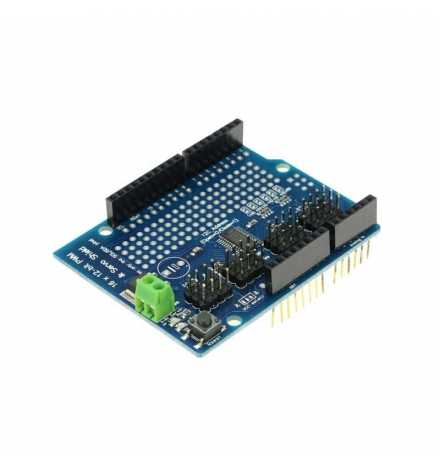
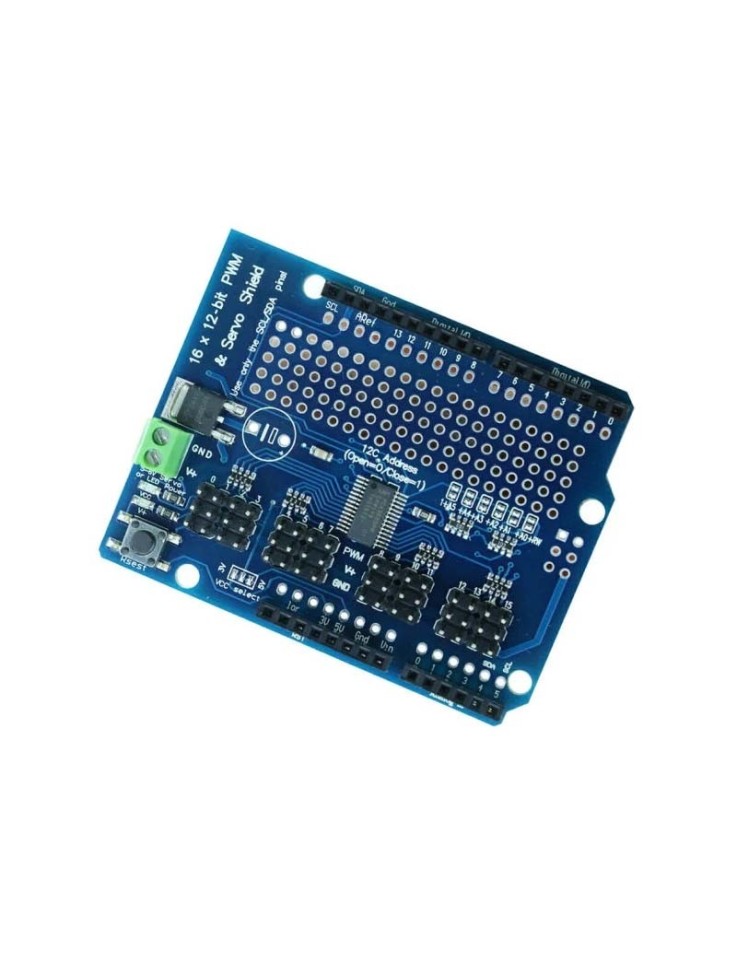
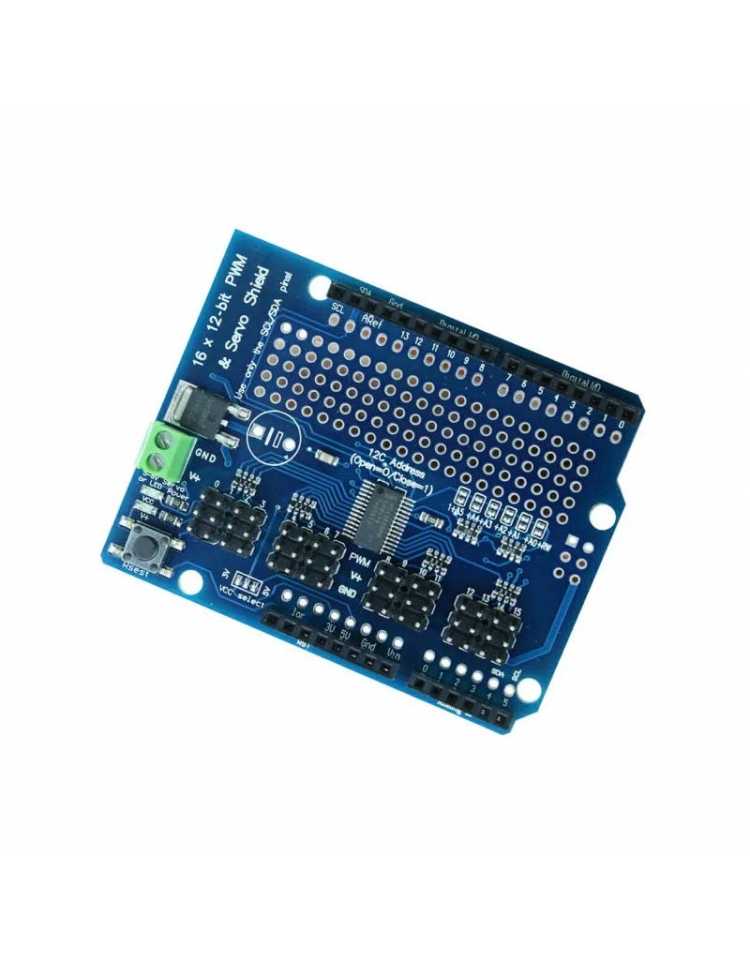
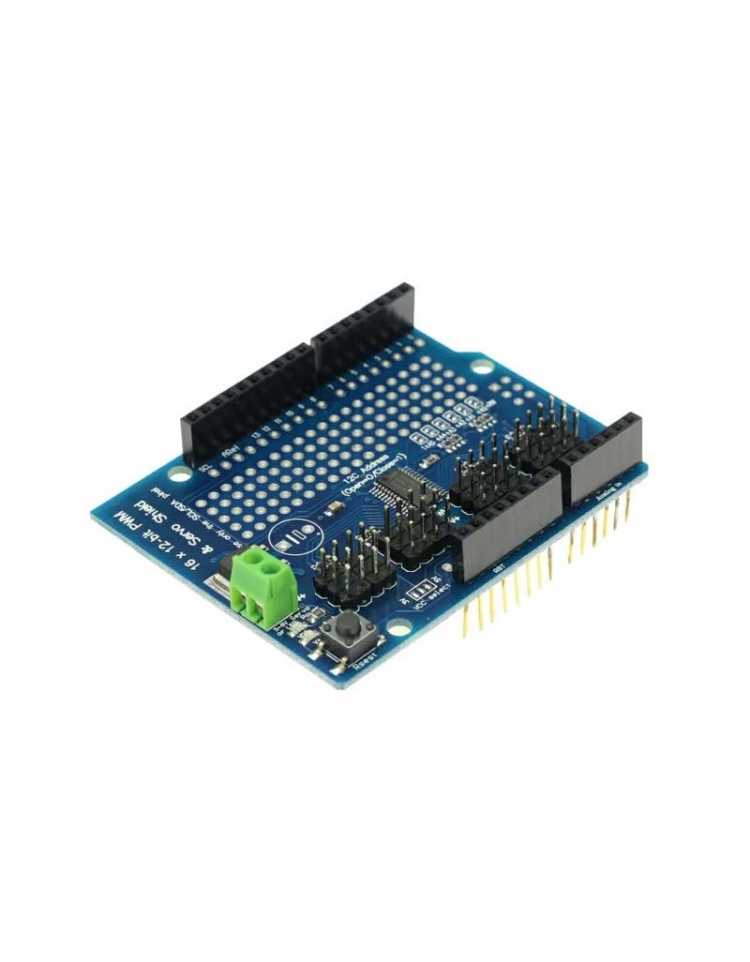
16 Channel I2C PWM/Servo Driver Shield
The Kuongshun PCA9685 16-Channel 12-bit PWM/Servo Driver Shield is the go-to I2C expansion board when your Arduino runs out of PWM pins. Built around the NXP PCA9685 chip, it offloads all PWM timing to dedicated on-board hardware, freeing your microcontroller to focus on logic rather than pulse generation. Whether you are driving 16 hobby servos for a robotic arm, controlling LED brightness arrays, or managing multiple DC motor speeds through external driver stages, this shield plugs directly onto an Arduino and communicates over just two wires (SDA + SCL).
Key Features
- 16 Independent PWM Channels: Drive up to 16 servos or PWM-controlled devices simultaneously from a single I2C address — no additional microcontroller pins required beyond SDA/SCL.
- 12-Bit Resolution per Channel: Each output offers 4096 discrete steps of duty-cycle control, delivering approximately 4 µs resolution at a 60 Hz update rate — ultra-smooth servo positioning and flicker-free LED dimming.
- Adjustable PWM Frequency up to ~1.6 kHz: The on-board oscillator allows you to tune the update rate from low frequencies ideal for servos (~50–60 Hz) up to ~1.6 kHz for fast motor or LED applications — one board covers a wide range of use cases.
- Built-in Clock (No External Crystal Needed): The PCA9685 integrates its own 25 MHz oscillator, meaning the shield works straight out of the box — simplifying wiring and reducing component count.
- Stackable / Chainable Design: Address pins allow multiple shields to be chained on the same I2C bus, expanding to up to 992 PWM channels — ideal for large-scale animatronics or LED installations.
- Separate Power Rail for Servos: A dedicated terminal block accepts an external power supply for the servo/motor rail, keeping high-current loads isolated from the Arduino's 5 V line — protecting your microcontroller from voltage drops.
Pinout & Wiring
| Pin / Terminal | Symbol | Description |
|---|---|---|
| I2C Data | SDA | Serial data line — connect to Arduino SDA (A4 on UNO) |
| I2C Clock | SCL | Serial clock line — connect to Arduino SCL (A5 on UNO) |
| Logic Power | VCC | 3.3 V – 5 V logic supply from microcontroller |
| Logic Ground | GND | Common ground |
| Servo Power + | V+ | External power input for servo/motor rail (use separate supply) |
| PWM Outputs 0–15 | CH0–CH15 | PWM signal + power pins for each servo/device channel |
| Address Pins | A0–A5 | Solder jumpers to set I2C address (default 0x40) |
| Output Enable | OE | Active-low pin to disable all outputs simultaneously |
Wiring note: Connect VCC and GND to the Arduino for logic power. Feed servos or motors from a separate supply via the V+ terminal block. On Arduino UNO/Mega the shield stacks directly; on other boards use jumper wires to SDA/SCL.
Compatibility
- Arduino UNO / Nano / Mega: 5 V logic — plug-and-play compatible; use the Adafruit PCA9685 library for quick setup.
- ESP32 / ESP8266: 3.3 V logic — fully compatible; the PCA9685 accepts 3.3 V–5 V on VCC. Assign SDA/SCL to appropriate GPIO pins in software.
- Raspberry Pi: 3.3 V I2C bus — compatible with the Pi's hardware I2C interface; use the corresponding Python library.
- Any I2C-capable microcontroller: The standard I2C protocol ensures broad platform support.
Typical Applications
- Multi-servo robotic arms & hexapods: Control 16 joints from a single Arduino shield — the most common maker use case for the PCA9685.
- Pan-tilt camera gimbals: Precise 12-bit positioning keeps camera movement smooth and jitter-free.
- RGB LED matrix dimming: Drive 16 channels of LEDs with independent brightness control at high update rates.
- RC car / drone prototyping: Generate ESC-compatible PWM signals for brushless motor speed controllers.
- Educational robotics & STEM projects: Ideal for students building their first multi-actuator robot without needing multiple microcontrollers.
Technical Specifications
| Specification | Value |
|---|---|
| Interface | I2C |
| IC / MPN | PCA9685 |
| Logic Voltage (VCC) | 3.3 V – 5 V |
| PWM Channels | 16 |
| PWM Resolution | 12-bit (4096 steps) |
| PWM Frequency | Up to ~1.6 kHz (adjustable) |
| Resolution at 60 Hz | ~4 µs |
| I2C Default Address | 0x40 |
| Chainable Addresses | Up to 62 (A0–A5 jumpers) |
| Category | Arduino Shield |
| Brand | Kuongshun |
FAQ
Q: Do I need an external library to use this shield with Arduino?
A: Yes — the Adafruit PCA9685 library (available in the Arduino Library Manager) is the most widely used and makes channel setup straightforward in just a few lines of code.
Q: Can I power servos directly from the Arduino's 5 V pin?
A: It is not recommended. Servos draw significant current that can overload the Arduino's onboard regulator. Always use a separate power supply connected to the V+ terminal block on the shield.
⚠ Note: Servos, motors, and external power supplies are not included. Always connect high-current servo loads to the dedicated V+ terminal — never draw servo power directly from the Arduino's 5 V rail.