Ελληνικά
Your cart
There are no more items in your cart


 Educational Products
 School Equipment
 Stationery
 STEM - Robotics - Programming
 Electronics
 Educational Toys & Construction Kits
 Tools & Adhesives
 Craft Materials
 Art Supplies
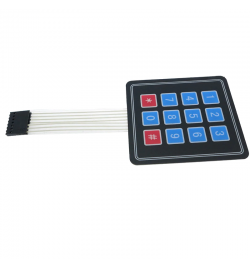
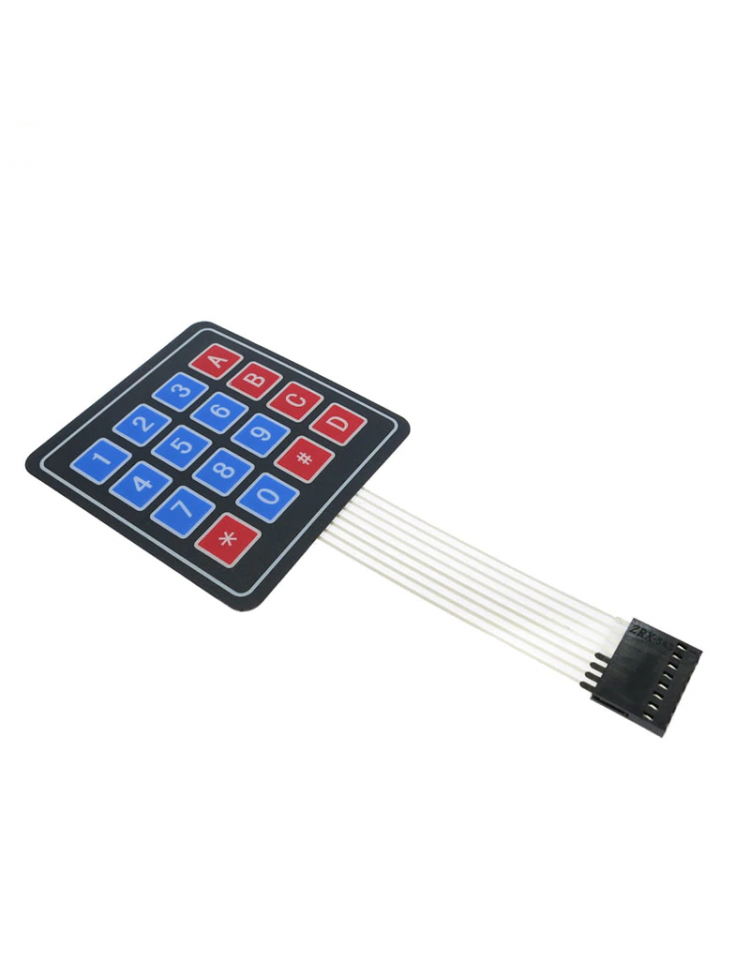
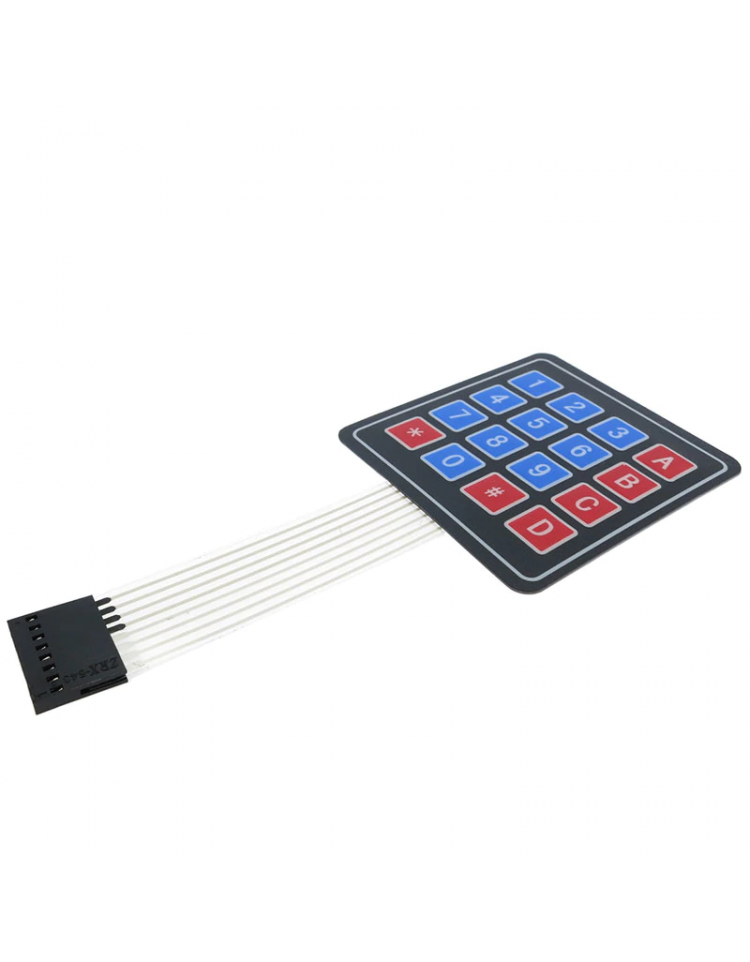
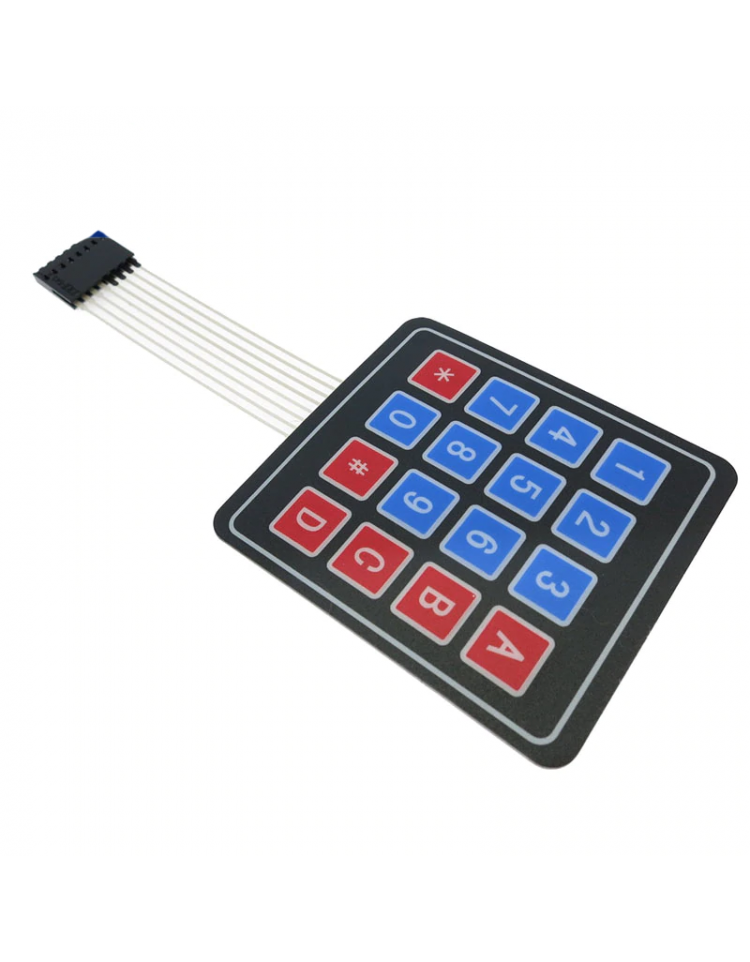
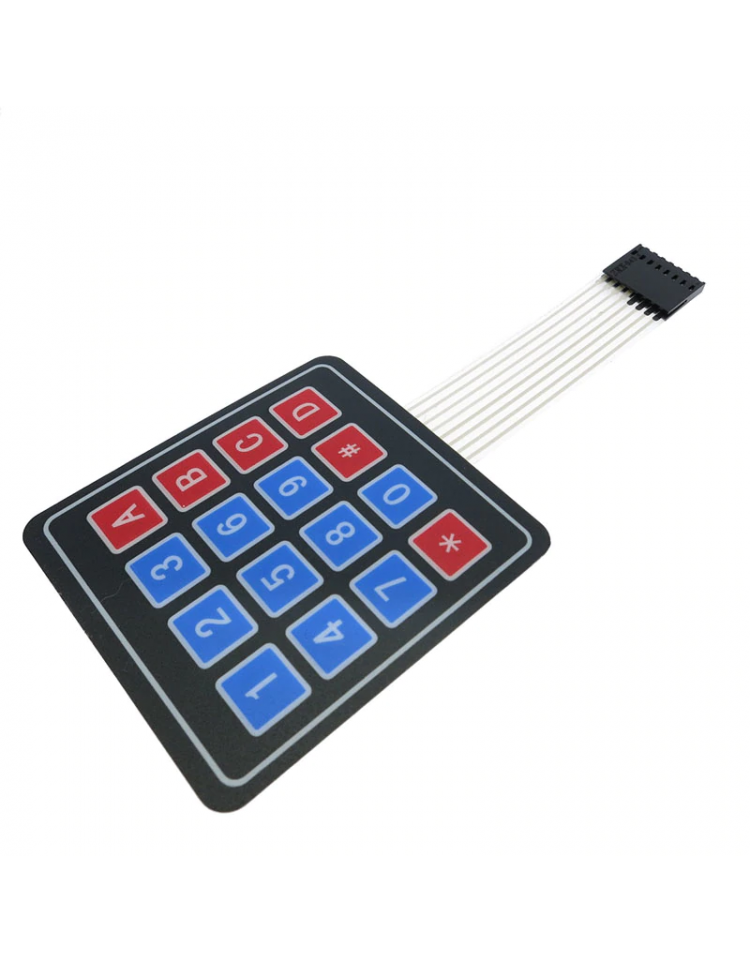
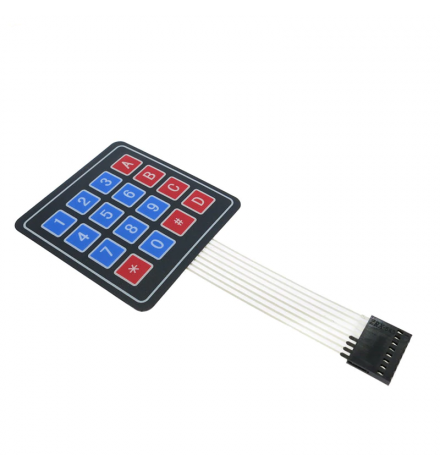
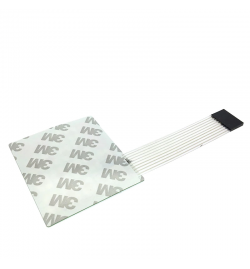
The Membrane 4×4 Matrix Keypad is a compact, ultra-thin 16-button input device designed for microcontroller projects. Featuring keys 0–9, A–D, *, and #, it uses a row-column matrix scanning method that requires only 8 GPIO pins to read all 16 keys — making it ideal for Arduino, ESP32, Raspberry Pi, and similar platforms. The adhesive backing allows quick, tool-free mounting on enclosures, panels, or prototyping surfaces.
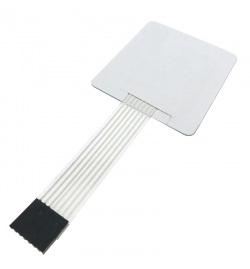
The keypad exposes an 8-pin ribbon cable with a 2.54 mm female connector. The first 4 pins correspond to Rows (R1–R4) and the last 4 pins to Columns (C1–C4).
| Pin | Symbol | Description |
|---|---|---|
| 1 | R1 | Row 1 — connect to microcontroller output GPIO |
| 2 | R2 | Row 2 — connect to microcontroller output GPIO |
| 3 | R3 | Row 3 — connect to microcontroller output GPIO |
| 4 | R4 | Row 4 — connect to microcontroller output GPIO |
| 5 | C1 | Column 1 — connect to microcontroller input GPIO (with pull-up) |
| 6 | C2 | Column 2 — connect to microcontroller input GPIO (with pull-up) |
| 7 | C3 | Column 3 — connect to microcontroller input GPIO (with pull-up) |
| 8 | C4 | Column 4 — connect to microcontroller input GPIO (with pull-up) |
Wiring note: Connect R1–R4 to 4 digital output pins and C1–C4 to 4 digital input pins (enable internal pull-ups). For Arduino, use the Keypad library for plug-and-play scanning. Example: R1→D9, R2→D8, R3→D7, R4→D6, C1→D5, C2→D4, C3→D3, C4→D2.
pinMode(pin, INPUT_PULLUP).| Parameter | Value |
|---|---|
| Interface | Direct GPIO (Row-Column Matrix Scanning) |
| Operating Voltage | 3V – 5V DC |
| Maximum Voltage (per key) | 24V DC |
| Maximum Current (per key) | 30 mA |
| Key Layout | 4×4 (16 keys: 0–9, A–D, *, #) |
| Pins Required | 8 GPIO (4 rows + 4 columns) |
| Connector Pitch | Female 2.54 mm |
| Key Bounce Time | ≤ 5 ms |
| Life Expectancy | 1,000,000 closures per key |
| Insulation Resistance | 100 MΩ @ 100V |
| Dielectric Withstand | 250V RMS @ 60Hz, 1 min |
| Operating Temperature | 0°C to 50°C |
| Keypad Dimensions | 69 mm × 79 mm |
| Cable Dimensions | 20 mm × 88 mm |
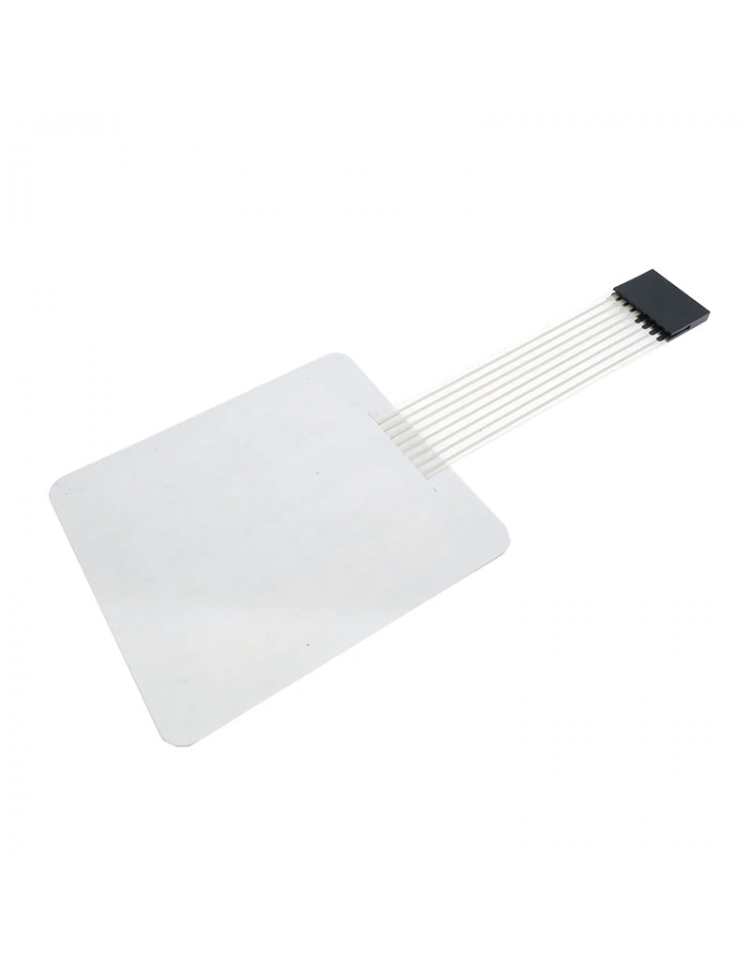
| Mounting | Adhesive backing (peel-and-stick) |
Q: Do I need a special library to use this keypad with Arduino?
A: Yes — the free Keypad library by Mark Stanley & Alexander Brevig (available in the Arduino Library Manager) handles all row/column scanning and debouncing automatically, so you only need to define your pin mapping and key map array.
Q: Can two keys be pressed simultaneously (N-key rollover)?
A: Standard membrane matrix keypads do not support true N-key rollover. Simultaneous key presses may cause phantom key readings. For single-key input applications (PIN entry, menu navigation) this is not an issue.
Package Contents: 1× Membrane 4×4 Matrix Keypad with pre-attached 8-pin ribbon cable (female 2.54 mm connector).