Ελληνικά
Your cart
There are no more items in your cart
 Educational Products
 School Equipment
 Stationery
 STEM - Robotics - Programming
 Electronics
 Educational Toys & Construction Kits
 Tools & Adhesives
 Craft Materials
 Art Supplies

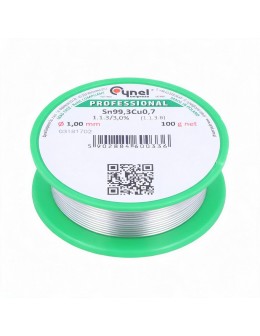
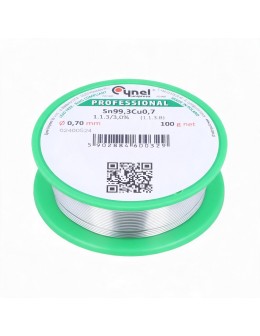
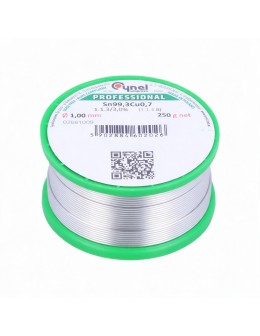
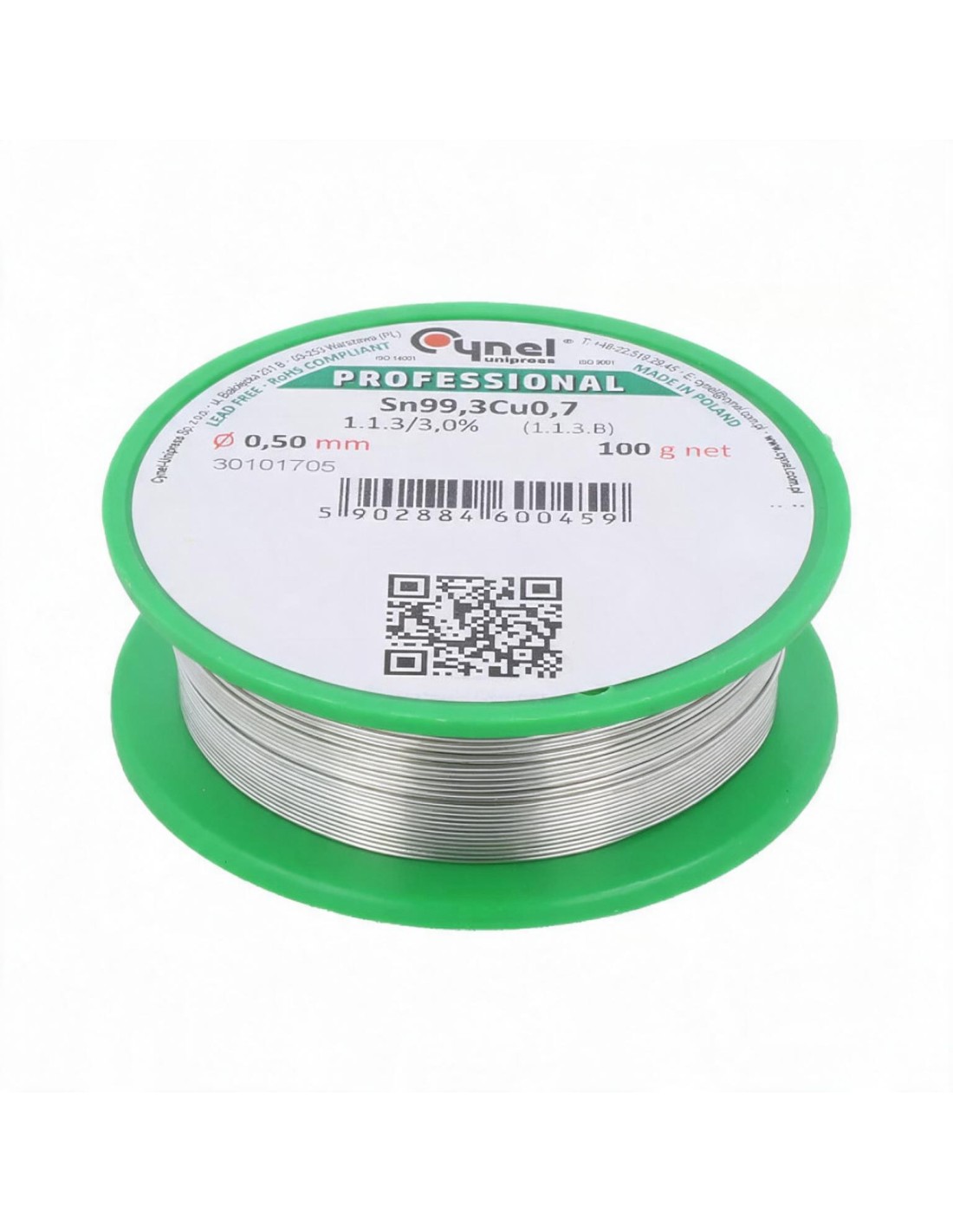
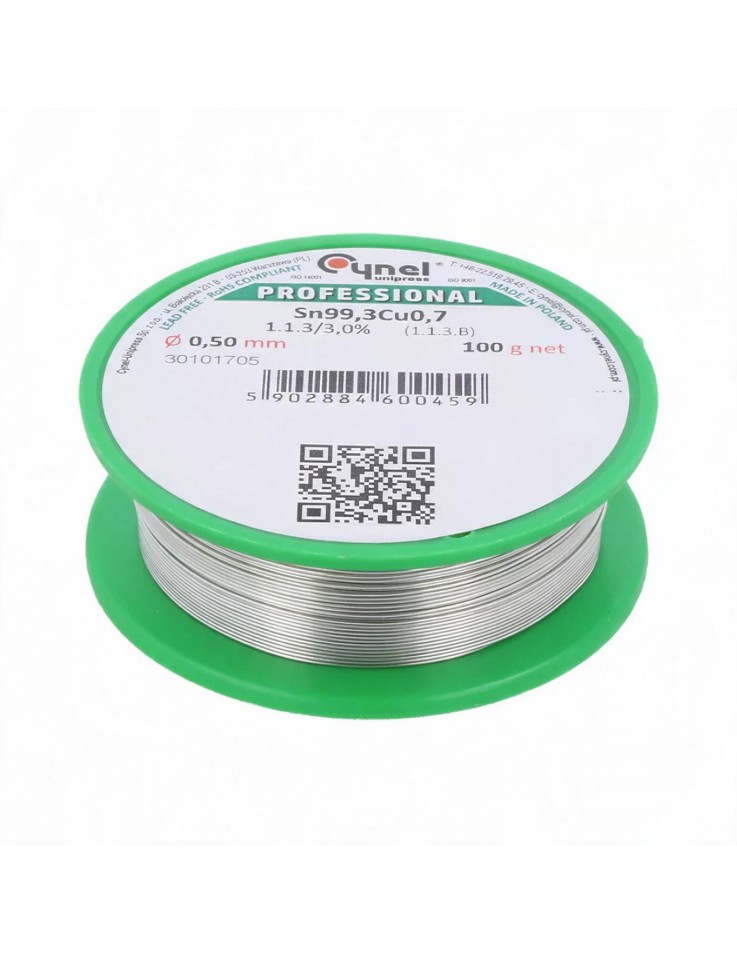
Cynel lead-free solder wire 0.5 mm on a 100 g (0.1 kg) reel, using the Sn99.3Cu0.7 alloy with an integrated SW26 flux core. Suited to SMD components, small through-hole parts and densely populated boards.
The Lead-Free Solder Wire 0.5mm 100gr Sn99.3Cu0.7 Cynel is a soft solder wire built on the Sn99.3Cu0.7 alloy (99.3% tin, 0.7% copper) with an integrated SW26 flux core. It melts at 227 °C and contains no lead, so it meets the requirements of the RoHS directive. In Cyprus this material is commonly called kalai and the soldering iron itself chafkia.
The 0.5 mm diameter makes it a fine solder wire, well suited to SMD components, small through-hole parts and densely populated boards. The 100 g reel covers occasional use, education and small projects.
The rule of thumb is simple: match the wire diameter to the width of the pad or conductor you are soldering. Wire that is too thin forces repeated passes on heavy work; wire that is too thick bridges pads on fine work.
| Diameter | Typical work |
|---|---|
| 0.25 mm | Precision work on SMD components, fine-pitch ICs and mobile-phone repairs |
| 0.5 mm ◀ this product | SMD components, small through-hole parts and densely populated boards |
| 0.7 mm | Fine PCB work, small through-hole components and electronics hobby projects |
| 0.8 mm | General PCB work, through-hole components, thin wires and connectors |
| 1 mm | Through-hole components, wiring, connectors, electrical repairs and school workshops |
| 2 mm | Heavy-gauge wiring, terminals, battery tabs, power connectors and surface tinning |
| 3 mm | Power connections, earthing, large metal masses and industrial work |
| Manufacturer | Cynel (Poland) |
|---|---|
| Type | Soft solder wire with integrated flux core |
| Alloy composition | Sn99.3Cu0.7 — 99.3% Tin (Sn) / 0.7% Copper (Cu) — lead-free |
| Alloy standard | ISO 9453 |
| Diameter | 0.5 mm |
| Net weight | 100 g (0.1 kg) |
| Melting point | 227 °C (eutectic) |
| Recommended tip temperature | 320–360 °C (up to 400 °C on nickel-plated parts) |
| Flux | SW26 — halide-activated modified rosin |
| Flux classification | DIN 8511: SW26 · ISO 9454-1: 1.1.2 · J-STD-004: ROL1 |
| Flux content | 2.2% ± 0.2% |
| Halide content | 0.5% |
| Specific weight | 7.31 g/cm³ |
| Tensile strength | 300 kg/cm² |
| Elongation at break | 21% |
| Hardness | 9 HB |
| Thermal conductivity | 66 W/m·K |
| Flux acid number | 180 mg KOH/g |
| Packaging type | Reel (spool) |
| RoHS compliance | Yes — Directive 2011/65/EU |
Will it work with the soldering iron I already own?
Yes. Solder wire is a consumable and works with any iron that reaches 320–360 °C (up to 400 °C on nickel-plated parts). For lead-free alloys a temperature-controlled iron of at least 60 W is recommended, especially on large metal masses.
Do I need separate flux (paste or liquid)?
For everyday work, no: the SW26 flux is built into the core of the wire and is released the moment the alloy melts. Extra flux only helps on oxidised surfaces, during desoldering or for SMD rework.
Do the joints need cleaning afterwards?
SW26 flux residue is classified ROL1 to J-STD-004 and is not corrosive under normal conditions, so it can usually be left in place. If you want a clean look or plan to apply conformal coating, remove it with isopropyl alcohol and a brush.
Why do the joints look dull rather than shiny?
That is normal. Sn99.3Cu0.7 lead-free alloys naturally produce a matte or slightly grainy surface. It is not a cold joint — what matters is the shape: a smooth fillet that wets both the pad and the lead.
Is it RoHS compliant?
Yes. The Sn99.3Cu0.7 alloy has a maximum lead content of 0.07% and meets Directive 2011/65/EU, so it is suitable for products placed on the EU market.
Can I use it over existing leaded solder?
Mechanically yes, but mixing the two alloys creates an intermediate melting point and a less reliable joint. When repairing an older board, remove the old solder first with desoldering braid or a pump.
How much solder do I need?
A 100 g reel comfortably covers a hobby project or occasional repairs, 250 g is the regular bench size, while 500 g and 1 kg reels suit service departments and production runs where changing reels costs time.
Supplied by Antoniadis Electronics-Educational Ltd, a supplier of electronic components, tools and STEM educational products. Manufacturer: Cynel Unipress, Poland.