Ελληνικά
Your cart
There are no more items in your cart

 Educational Products
 School Equipment
 Stationery
 STEM - Robotics - Programming
 Electronics
 Educational Toys & Construction Kits
 Tools & Adhesives
 Craft Materials
 Art Supplies
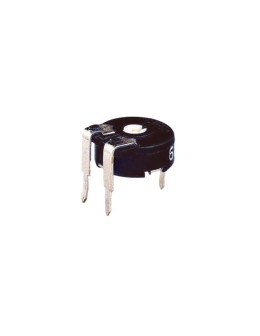
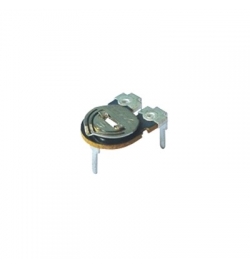
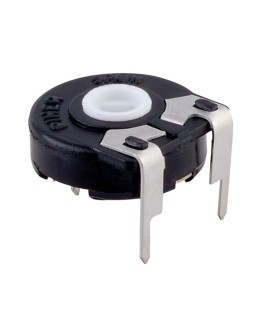
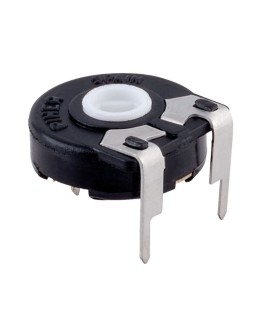
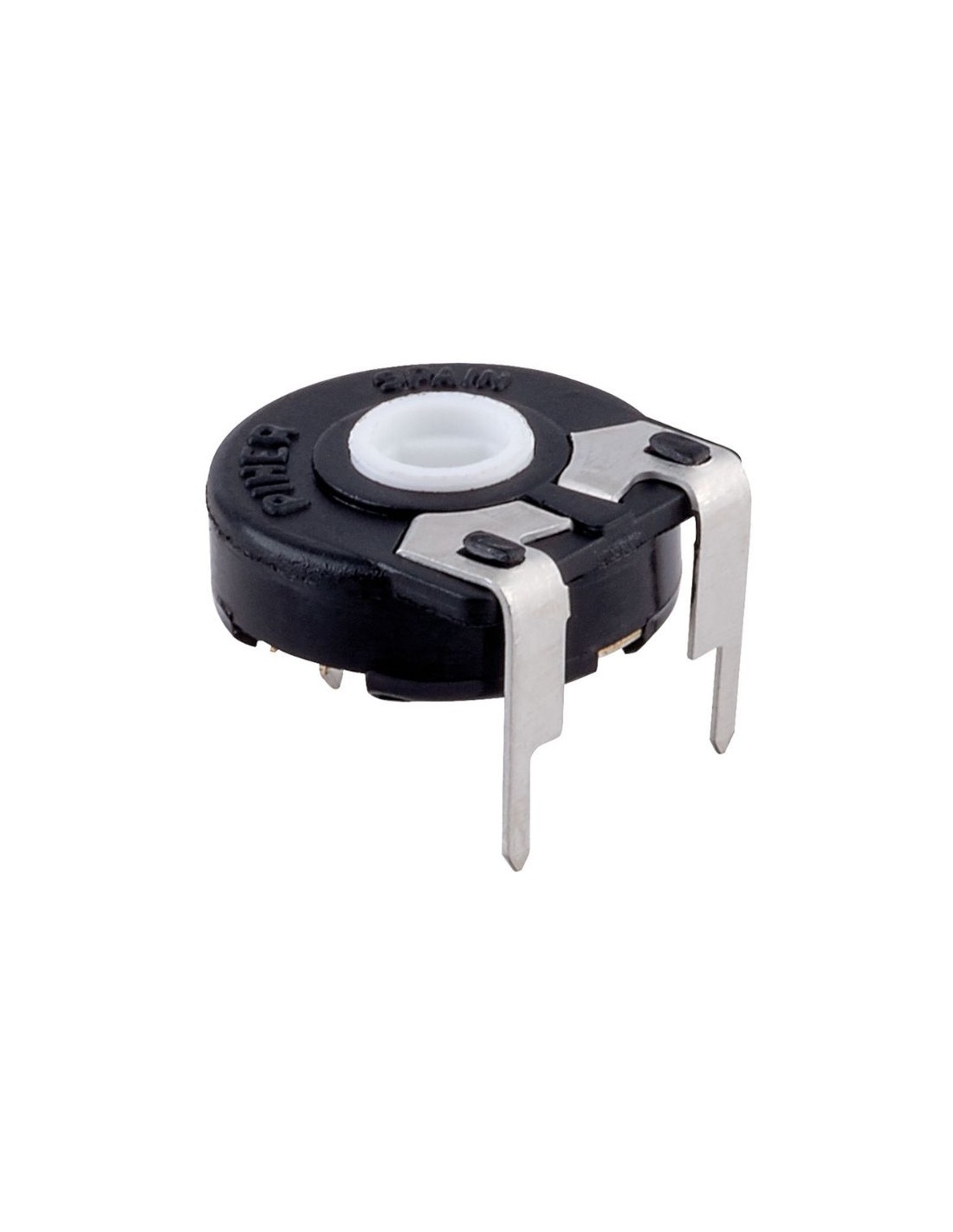
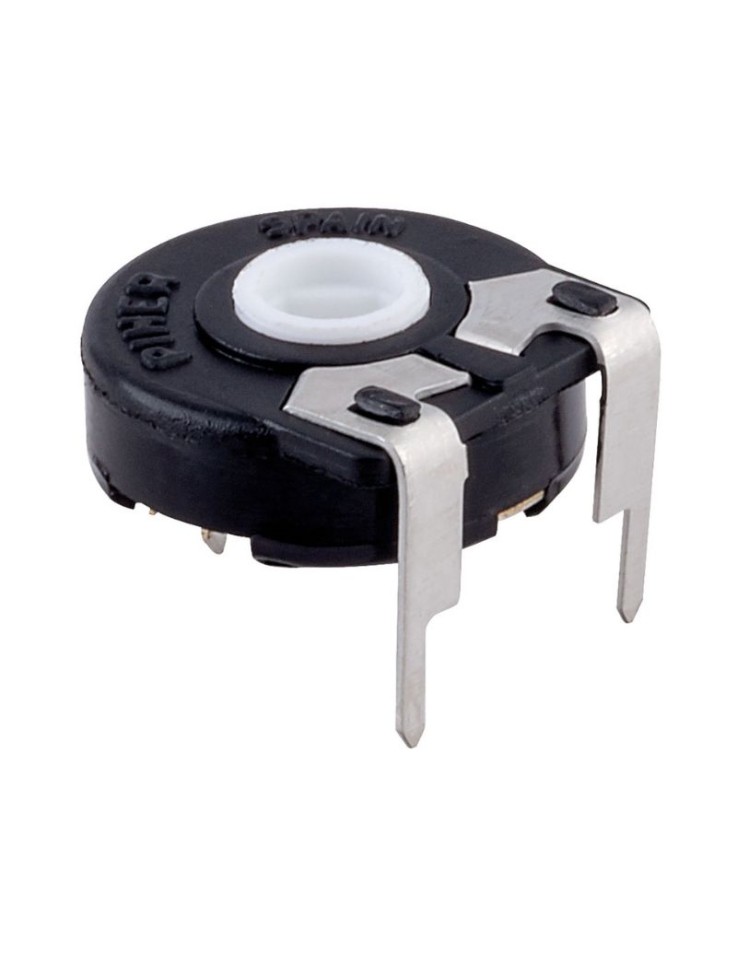
Trimmer / preset potentiometer 220kΩ, enclosed type, 15 x 15 mm body, single turn with linear taper. For through-hole horizontal mounting (the body lies flat on the PCB), adjusted with a flat-blade screwdriver from the top face. Rated 0.25 W, tolerance ±20%, operating temperature −25 °C to +70 °C. Ideal for calibration and set-and-forget adjustments.
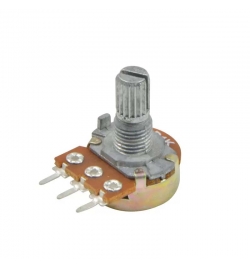
A trimmer or preset is a small variable potentiometer mounted on the PCB and adjusted with a screwdriver rather than by the end user. It is used for settings made once during manufacturing or servicing that then stay put — unlike shaft potentiometers, which the user turns constantly. This one has a nominal resistance of 220kΩ, an enclosed 15 x 15 mm body and horizontal mounting (the body lies flat on the PCB).
High values are used in RC timing circuits (e.g. 555 timers), oscillators, high-impedance bias networks and stages where current must stay very low.
| Resistance | 220kΩ (IEC code 220K — marking 224) |
|---|---|
| Resistance tolerance | ±20% |
| Type | Trimmer / preset potentiometer, single turn |
| Taper | Linear |
| Body size | 15 x 15 mm (enclosed) |
| Mounting | Through-hole (PCB) — horizontal mounting (the body lies flat on the PCB) |
| Adjustment | Slot for flat-blade screwdriver, from the top face |
| Typical pin pitch | 2.54 mm |
| Power rating | 0.25 W at 50 °C |
| Max. working voltage | 250 VDC |
| Temperature coefficient | ±300 ppm/°C (for values < 100 kΩ) |
| Rotation angle | Mechanical 265° ±5° / electrical 240° ±20° |
| Rotational torque | 0.5 - 2.5 Ncm (stop torque > 10 Ncm) |
| Resistive element | Carbon on polyester substrate |
| Operating temperature | −25 °C to +70 °C |
| Protection | Enclosed (sealed) body, dust resistant |
| Terminals | 3 (ends 1 and 3, wiper on 2) |
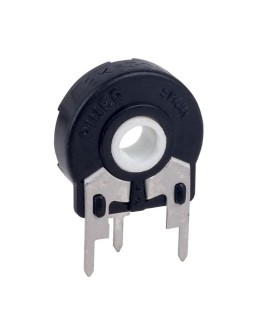
The same resistance value is also available as: 10mm horizontal, 10mm vertical, 15mm vertical.
Before soldering, check the PCB footprint: both the orientation (horizontal or vertical) and the three-pin layout must match. When adjusting, use a correctly sized flat-blade screwdriver and do not force the shaft past its mechanical limits, as this stresses the internal stop. To measure the resistance, do so with the part out of circuit.
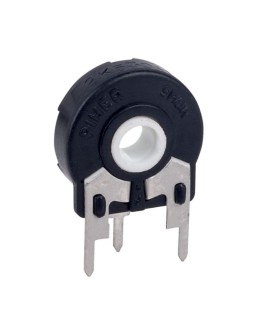
Both share the same electrical element; only the way they sit on the board changes. On the horizontal version the body lies flat and you adjust from above, while on the vertical version the body stands upright and you adjust from the side. The choice depends on screwdriver access and on the PCB footprint. This item is the horizontal version; the vertical one is also available in the same value.
This is a single-turn potentiometer with a mechanical rotation of 265° ±5°, so the full range is covered in less than one complete turn. That makes it fast for routine adjustment. If you need fine trimming over a very narrow range, choose a multiturn trimmer instead.
The power rating is 0.25 W at 50 °C for the whole element, with a maximum working voltage of 250 VDC. Note that when used as a rheostat (two terminals), the permissible power is reduced in proportion to the part of the track actually in circuit.
Yes. Connecting the wiper (centre terminal) to one of the two ends turns the potentiometer into a two-terminal rheostat. As a voltage divider you use all three terminals, taking the output from the wiper.
On carbon trimmers the tolerance of the nominal value is deliberately wide, because the exact resistance is set by your adjustment rather than at the factory. What matters is that the range covers the value you need, which is ensured by choosing the right nominal value.